Get Paid by US Clients in USD, Into Bank Details in Your Own Name
A US client pays a routing number and an account number, the way they pay anyone. Behind those details, what arrives converts to USDC and lands in your wallet.
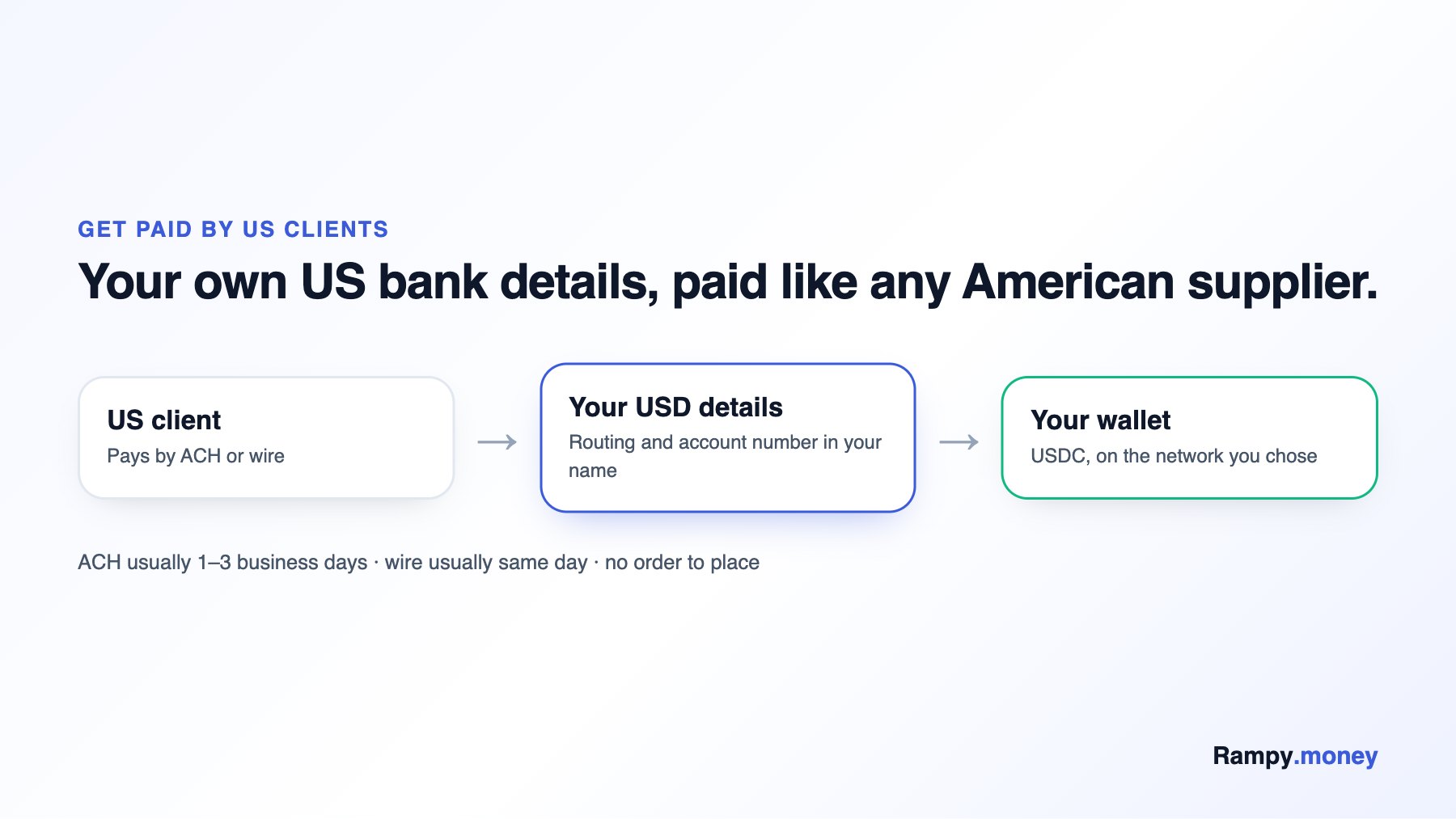
Most US companies pay their suppliers by ACH or by wire. Ask one to pay a foreign bank and the request goes to someone in finance who has to set up an international wire, find a SWIFT code, and accept that intermediary banks may take a cut on the way. Ask them to pay a US routing number and an account number and it is the payment they make every day.
A USD deposit account gives you exactly that: US bank details issued in your name. Your client pays them like any American supplier. Whatever arrives is converted to USDC and sent to your wallet, with no order to place.
How it works
- Verify your identity once. The verification page lists the currencies switched on for your account under Where you can be paid.
- On Get paid, open USD bank details. Choose the stablecoin and the network you want, for example USDC on Base or Solana, and which of your wallets it goes to.
- Send your client the details: account holder name, routing number and account number. They are permanent, so they can go on every invoice.
- Your client pays by ACH, usually one to three business days, or by wire, usually the same day.
- When the money lands it converts at 1.99% and arrives in your wallet. You get an email each time.
What it costs
| USD deposit account | |
|---|---|
| Rampy's fee | 1.99% of each deposit, no fixed fee |
| On a $2,000 invoice | $39.80 |
| On a $500 invoice | $9.95 |
| Suggested minimum per payment | 100 USD |
| Monthly charge for the account | None |
The receipt for each deposit shows what arrived and what it converted to. Smaller payments still convert below 100 USD, but cost proportionally more, because delivering the stablecoin has a cost that does not shrink with the amount.
Who can pay into it
This is the part to read before you send the details to anyone. The rules come from our banking partner and depend on who is paying:
| Paying from | Accepted? |
|---|---|
| A registered business, including payroll | Yes. Larger payments can be held for review and returned if they cannot be verified |
| Your own bank, fintech app or brokerage account | Yes, unlimited |
| Another person's personal account | Under $4,000 per payment. A family member who shares your surname may send any amount. Not accepted from New York or Texas. |
One more limit applies to US residents: without a photo ID on file, you can receive up to $100,000 in total before our partner asks for one.
ACH or wire?
| ACH | Wire | |
|---|---|---|
| Usually arrives | 1–3 business days | Same day |
| Cost to your client | Usually free | Their bank may charge |
| Good for | Regular invoices | Larger or urgent payments |
Before you rely on it
- There is no order to cancel. Whatever arrives converts. If a client pays an invoice twice, it converts twice.
- The details are permanent. Turn them off on the Bank accounts page if you stop needing them, and back on whenever you like.
- Most new accounts get their bank details straight away; some are looked at by a person first, usually within one business day. For the first 7 days, a new account can bring in up to $2,000 in total.
- Everything you are paid, and every conversion, is on your statement in the app.
USD bank details in your name. US clients pay by ACH or wire; you receive USDC at 1.99%, with no fixed fee.
Open USD bank detailsFrequently asked
Do I need a US company or a US bank account?
No. You verify with Rampy, and if US dollars are switched on for your account, the USD details are issued to you. You do not open a US bank account yourself.
Can my client pay by card?
No. These are bank details, so payment is by ACH or wire.
What do I receive?
The stablecoin and network you chose when you opened the details, for example USDC on Base, sent to your Rampy wallet or a wallet app you have linked.
Can a private individual pay me?
Yes, under $4,000 per payment, or any amount from a family member who shares your surname. Payments from New York or Texas residents' personal accounts are not accepted.