Is Rampy Safe? Who Holds Your Money, and What If We Disappeared
Rampy is the app, not the place your money sits. Here is who holds it at each step, what protects your account, and the risks we cannot take away.
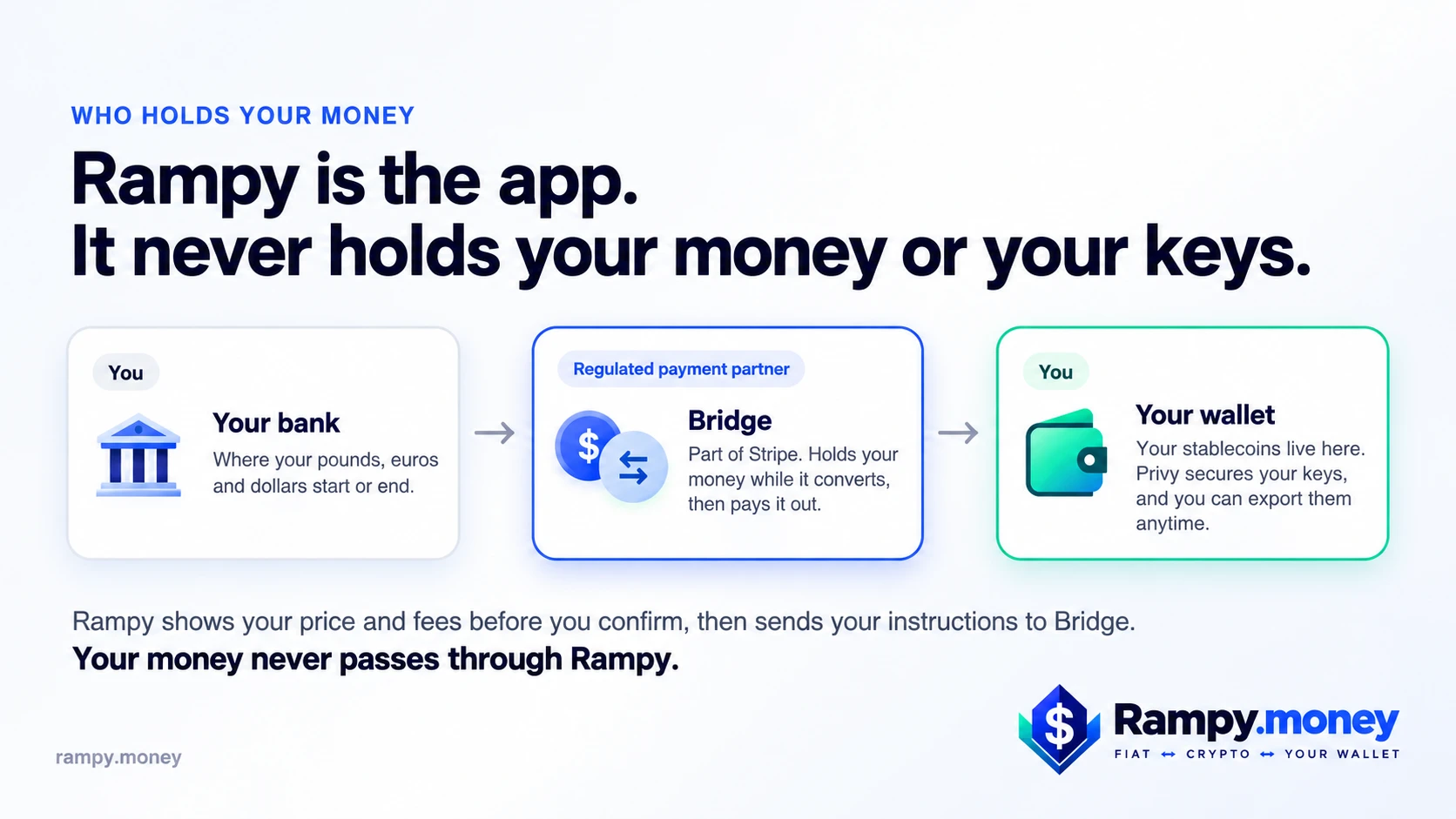
The short answer: Rampy is a software interface. We do not take custody of your money or your stablecoins. Money moves between your bank, our regulated payment partner and your own wallet, and at no point does it sit with us. That changes what "safe" means, so this post goes through who holds what, and what each of them can and cannot do.
Who holds your money, step by step
- Your bank holds your pounds, euros or dollars until you send them.
- Bridge, our payment partner and part of Stripe, holds the money only while it converts, then pays it out. Depending on where you live you contract with Bridge Building Inc in the US (NMLS #2450917), Bridge Building S.A. in the European Economic Area, or Bridge Building Limited everywhere else, the UK included.
- Your stablecoins sit in your own wallet. Its keys are kept in a secure enclave by our wallet provider, Privy, and you can export them at any time and use them in any other wallet, without asking us.
What Rampy does is price the order, show you every figure before you confirm, and tell our partner what you asked for. If you want the longer version of why that matters, our guide to custodial and non-custodial services goes through it.
Who checks your identity
Our payment partner does, through its verification provider, Persona. Your identity documents go to them, not to us. That is also why a question about your documents, or a request to explain where money came from, comes from our partner's process rather than from Rampy's own judgement.
What protects your account
- No passwords to steal: you sign in with a one-time code sent to your email.
- A second code before anything that moves where money goes: adding a bank account, pointing an address at a different account, or changing who is on your team.
- An email whenever one of those changes, and whenever a new device signs in, so a change you did not make does not go unnoticed.
- Sign out everywhere, from Settings, if you ever think someone else has your session. Idle sessions sign themselves out.
What if Rampy disappeared tomorrow?
Your stablecoins are in your own wallet, so they would not disappear with us. Back up your wallet from the Wallet page by importing its recovery phrase into a wallet app of your choice; with it you can move everything without us. An order that was already moving is with our payment partner, which completes it or returns the money. There would be nothing to claim from Rampy, because we hold nothing of yours.
What nobody can protect you from
- Stablecoins are not bank deposits. They are not covered by the UK's FSCS, the US FDIC or the EU's deposit guarantees, and a stablecoin is only as good as the company that issues it.
- A payment on a blockchain cannot be reversed. Sending to the wrong address, or on the wrong network, is often permanent.
- Scams. Nobody from Rampy will ever ask for your sign-in code, your wallet key, or for you to send coins somewhere "to keep them safe". Anybody who does is not us.
- Losing both your device and your wallet's recovery phrase. Back it up once, in a wallet app or on paper kept offline.
How the product is built, in more detail: what protects your orders and what we log.
Security at RampyFrequently asked
Does Rampy hold my money?
No. Money moves between your bank, our regulated payment partner and your own wallet. Rampy is the software that arranges it and never takes custody.
Can Rampy freeze my stablecoins?
No. We can close our app to an account, but your wallet and its keys are yours, and you can move what is in it with any wallet app.
Who do I contract with?
With Rampy for the app, and with the Bridge entity for where you live for the payments themselves: Bridge Building Inc in the US, Bridge Building S.A. in the EEA, and Bridge Building Limited elsewhere, the UK included.
Are my stablecoins insured?
No. Stablecoins are not bank deposits and are not covered by deposit-guarantee schemes such as the FSCS or the FDIC.