Non-Custodial vs Custodial: What It Means for Your Money
Not your keys, not your coins is a slogan, but it describes a real legal distinction that decides what happens if a company collapses.
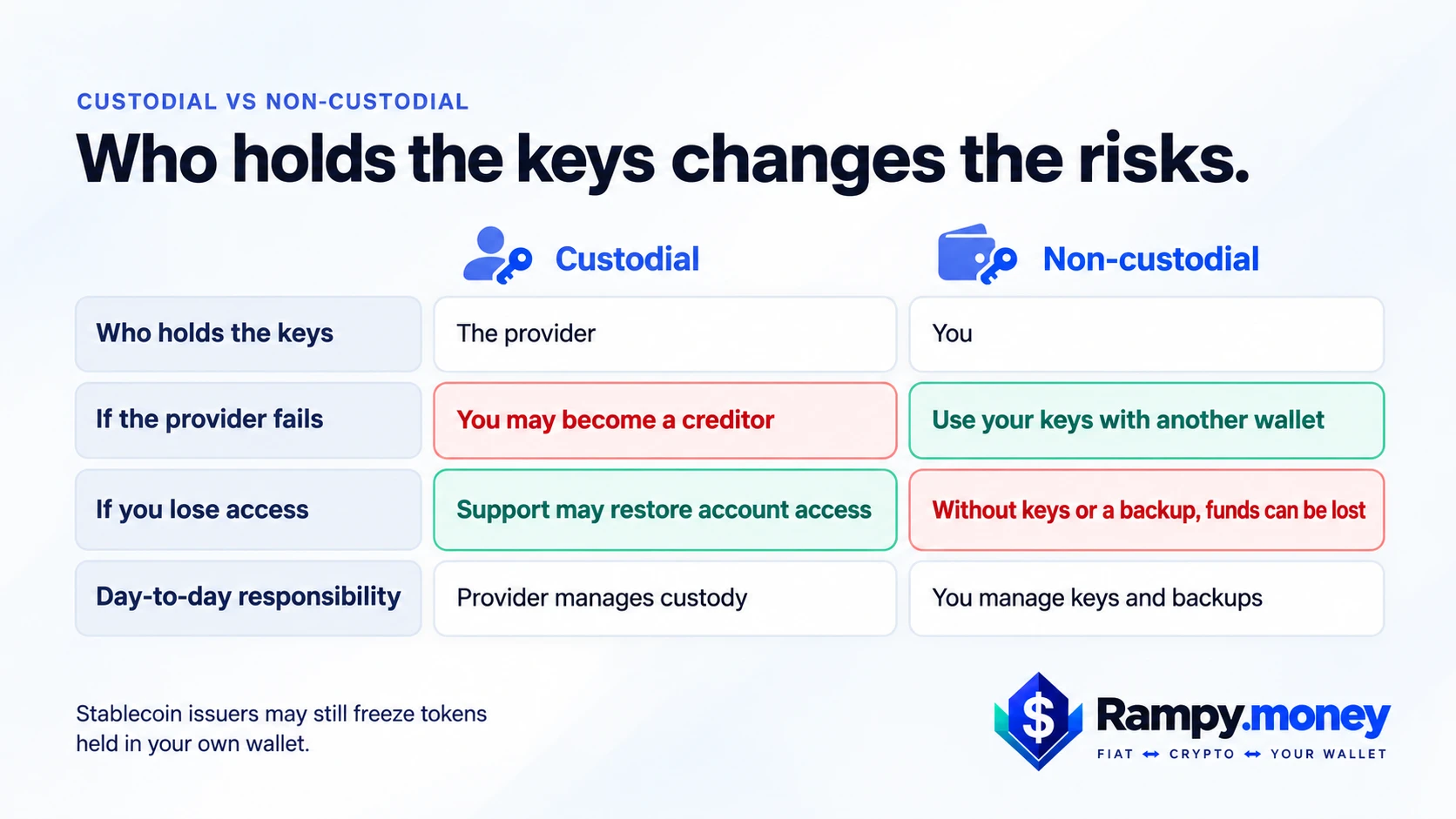
Custody is the question of who holds the private keys that control your crypto. It sounds technical. It is really a question about what happens to your money when something goes wrong, and it has been answered painfully in public several times.
The difference
| Custodial | Non-custodial | |
|---|---|---|
| Who holds the keys | The provider | You |
| If the provider fails | You are a creditor | Your assets are unaffected |
| If you lose your keys | Support can restore access | Funds are gone permanently |
| Convenience | Higher | Lower |
| Who bears the risk | The provider, then you | You |
What custodial really means
When an exchange holds your crypto, you do not own specific coins. You hold a claim against that company. Day to day this is invisible and convenient: password resets work, support can help, and you never think about seed phrases. In an insolvency it matters enormously, because you join the queue of unsecured creditors. Several exchange collapses have demonstrated exactly this, and customers recovered fractions of their balances after years.
What non-custodial really means
You hold the keys. No company can freeze, lend or lose your assets, because no company has them. The other side is absolute: there is no password reset. Lose the seed phrase and the funds are unreachable forever, by you and by everyone else. That responsibility is not theoretical, and a meaningful share of all Bitcoin is believed lost this way.
Where off-ramps sit
Some off-ramps are custodial: you deposit, they hold, they pay out. Others are non-custodial: funds move from your wallet, get converted in transit, and the fiat lands in your bank without anyone holding your crypto meaningfully. The second reduces the window in which someone else's failure can affect you.
Be precise about the claim, though. Any service converting to fiat necessarily touches the money briefly during conversion, and the fiat leg is handled by regulated partners. Non-custodial means nobody holds your private keys, not that money never moves through anyone else's system.
Which should you choose?
- Actively trading, small balances, value convenience: custodial is a reasonable trade.
- Holding meaningful amounts long term: non-custodial, with a properly backed-up seed phrase.
- Cashing out to a bank: a non-custodial off-ramp limits how long anyone else controls your funds.
- Either way: never keep more on an exchange than you would be willing to lose.
Rampy is non-custodial. We never hold your private keys, and stablecoins settle directly to the wallet you control.
See how it worksFrequently asked
What does 'not your keys, not your coins' mean?
If someone else holds the private keys, you hold a claim against that company rather than the asset itself. In an insolvency you become a creditor rather than an owner.
Is non-custodial always safer?
It removes provider risk but transfers all responsibility to you. A lost seed phrase cannot be recovered by anyone, so it is safer only if your key management is sound.
Can a non-custodial service still freeze my funds?
It cannot freeze assets in your own wallet. However, stablecoin issuers such as Circle and Tether can freeze specific addresses at the token level, independently of any service you use.