Who Can Pay Into Your Deposit Account? The USD, EUR and GBP Rules Side by Side
A deposit account looks like an ordinary bank account, and the rules on who may pay it are not ordinary. They differ by currency, and the wrong payer costs a week.
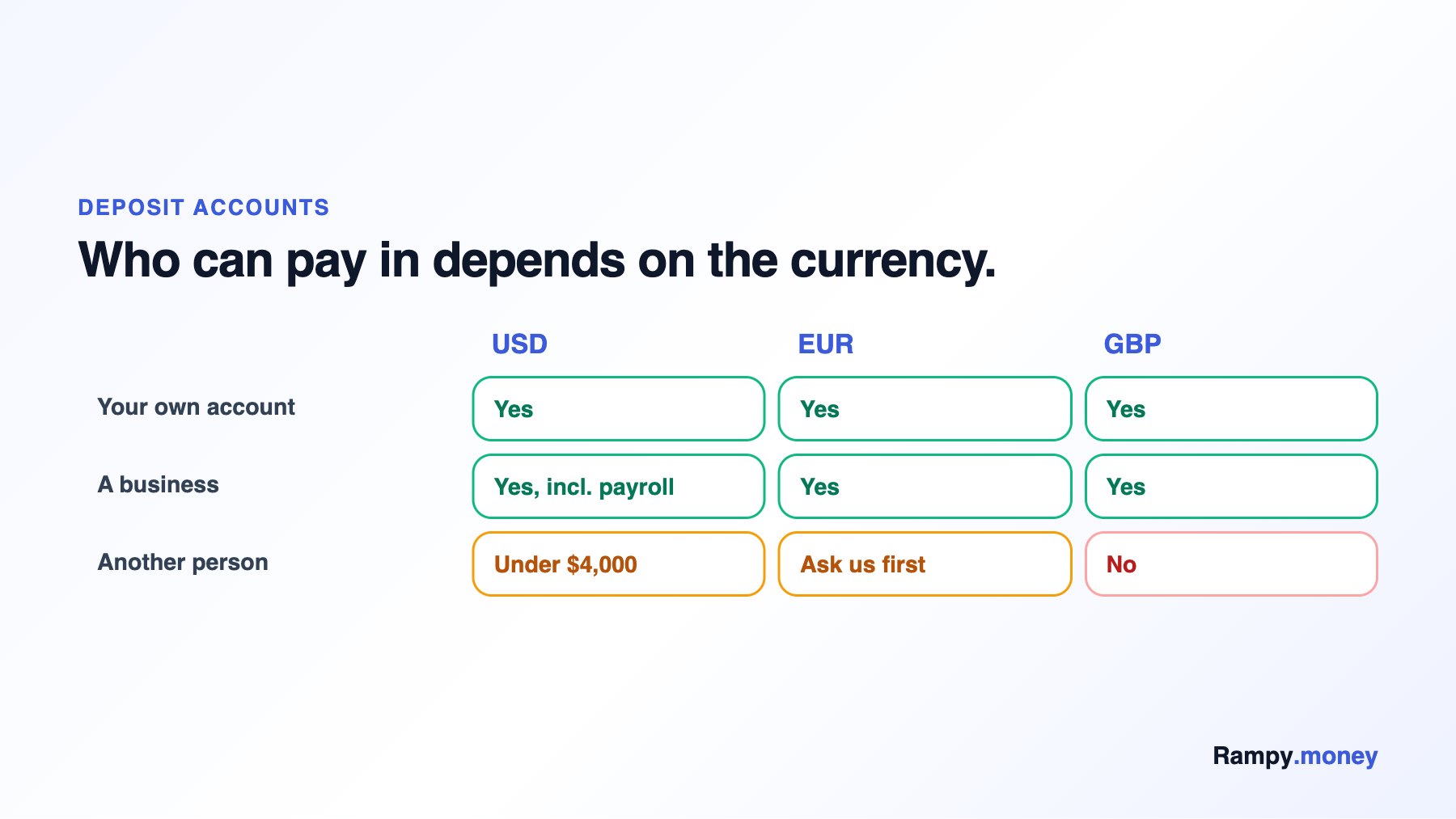
Permanent bank details look like an ordinary account, so people use them like one: they hand them to a client, a relative, a friend who owes them money. But the rules about who may pay in come from the payment network and our banking partner, they differ by currency, and they are stricter than a high-street account.
Getting it wrong does not fail politely. A payment from a sender the rules do not allow is not refused when it is sent. It arrives, goes to review, and is returned days later, usually after you have told the sender it worked.
The rules, side by side
| Paying from | USD | EUR | GBP |
|---|---|---|---|
| Your own account | Yes | Yes | Yes |
| A business | Yes | Yes | Yes |
| Another person | Under $4,000 | Ask us first | No |
| Very large payments | — | Over €1m: next day | Over £1m: 3 days |
| Verified in the EU | Not stated | Yes | No |
The detail behind each answer:
- USD, your own account: unlimited, including from a fintech app or a brokerage account.
- USD, a business: accepted, including payroll. Larger payments can be held for review by our partner and returned if they cannot be verified.
- USD, another person: under $4,000 per payment. A family member who shares your surname may send any amount. Not accepted from New York or Texas.
- EUR, another person: not enabled by default. Write to us before asking someone to pay you, or the payment is likely to be returned.
- GBP, another person: not accepted. A payment sent anyway is likely to be returned rather than refused when it is sent.
- Very large payments: over €1,000,000 moves by SEPA Credit and takes one business day; over £1,000,000 moves by BACS and takes three business days.
These are our banking partner's rules as published for each payment network, checked on 20 September 2026. If they change, this page changes with them.
How to avoid a returned payment
- Before anyone pays, tell them which kind of account to pay from. The pay link on Get paid does this for you, in the payer's own words.
- For business invoices, any of the three currencies works. For payments from private people, USD under $4,000 is the only one that accepts them by default.
- If someone cannot pay your bank details, they can pay in stablecoins instead, to your wallet or to a crypto address from Get paid that converts to your bank.
- Keep each payment at 100 or more. Smaller ones still convert, at a proportionally higher cost.
Two more limits worth knowing
- US residents without a photo ID on file can receive up to $100,000 in total before our partner asks for one.
- Most new accounts get their bank details straight away, though some are looked at by a person first, and for the first 7 days a new account can bring in up to $2,000 in total.
Open USD, EUR or GBP bank details, and send payers a link that tells them how to pay.
Open a deposit accountFrequently asked
What happens to a payment from someone who is not allowed to pay in?
It is usually returned to the sender after a review, which can take several days. It is not refused at the moment it is sent.
Can my employer pay my salary into a deposit account?
Yes. Payments from a registered business, including payroll, are accepted on USD, EUR and GBP details.
Can I have deposit accounts in more than one currency?
Yes, one in each currency switched on for your account. The verification page lists them under Where you can be paid.
Can a friend pay me in pounds?
Not into GBP details: payments from another person's personal account are not accepted there. They could pay you in stablecoins instead.