The Cheapest Way to Convert Crypto to Cash (Fees Compared)
The advertised rate is rarely what you pay. Here is how the costs actually stack up, and where the money quietly disappears.
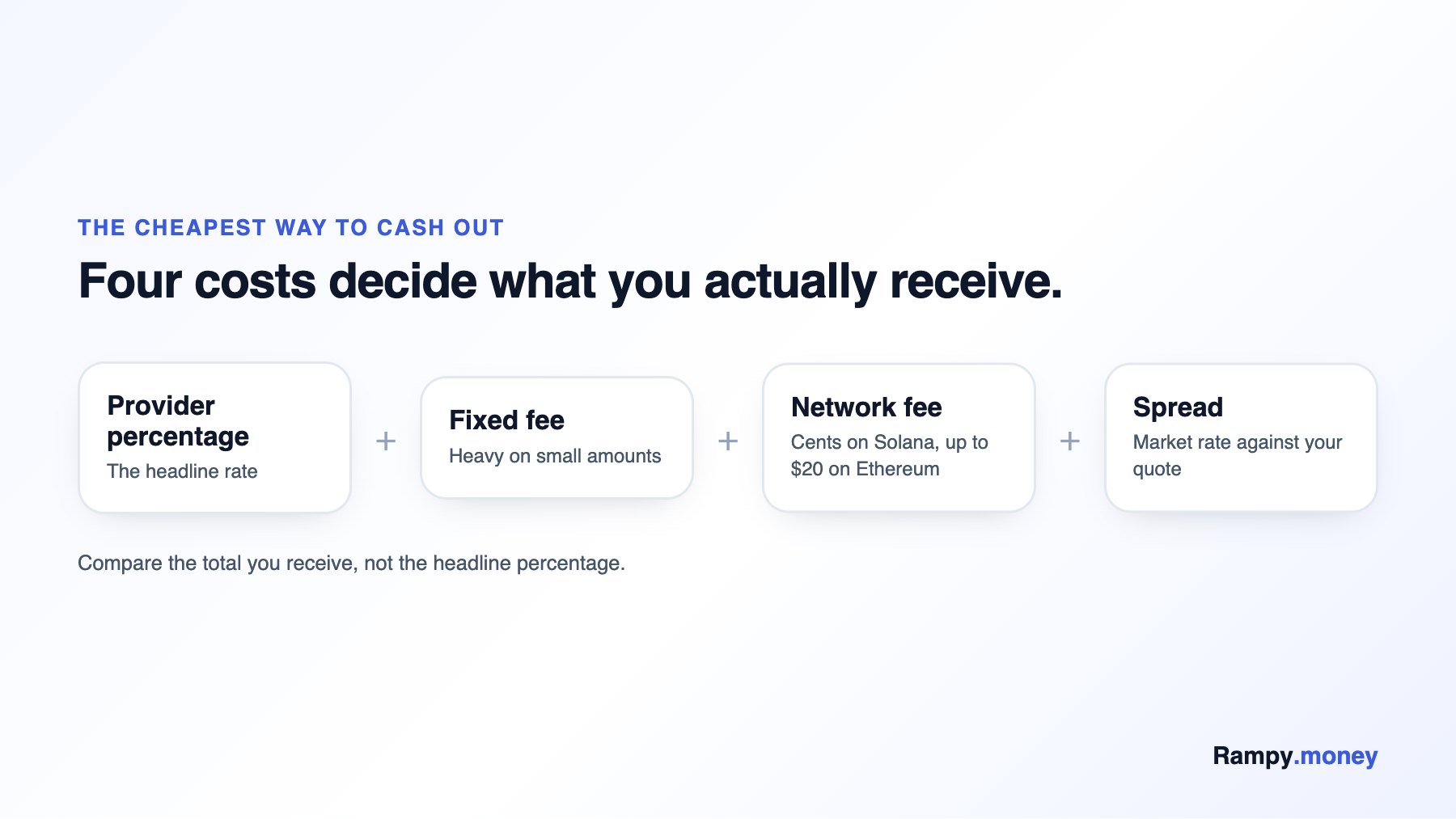
Ask what it costs to convert crypto to cash and you will get a percentage. That number is usually incomplete. The real cost is the provider's percentage, plus any fixed fee, plus the network fee, plus the spread between their quoted rate and the market rate. Only the first is ever advertised.
The four costs to add up
- Provider percentage. The headline rate, typically 0.5% to 5.5%.
- Fixed fee. A flat charge per payout, brutal on small amounts and irrelevant on large ones.
- Network fee. The blockchain cost of moving the coins, cents on Solana, potentially $20 on Ethereum.
- Spread. The gap between the market rate and the rate you are quoted. Usually invisible.
Published rates in 2026
| Provider | Sell to bank | Structure |
|---|---|---|
| Rampy | 1.99% + 1.99 below 500, then 0.99% + 1.99 from 500 | One rate on every rail, plus a fixed fee per order |
| Ramp Network | 0.49% – 2.9% | Cheapest on SEPA, dearest on US ACH |
| Transak | 0.5% – 5.5% | Card payouts at the top end |
| MoonPay | 1% + $3.99 | Percentage plus a fixed fee |
| Major exchange | 0.1% – 1.5% | Plus withdrawal fee, requires custody |
Ranges exist because most providers charge differently by payment rail and country. A quoted floor of 0.49% may apply only to SEPA in one region while your ACH payout sits near the ceiling.
Fixed fees change the answer entirely
Almost every provider charges a percentage plus a flat amount, and the flat part is what decides who is cheapest. Ours is 1.99% + 1.99 below 500, then 0.99% + 1.99 from 500. A lower percentage with a bigger fixed fee — 1% plus $3.99, say — looks cheaper in the headline, and which one wins depends on the amount. Against 1% plus $3.99 we are cheaper below $203, that provider is cheaper from $203 to $499, and we are cheaper again from $500 up, because our rate drops to the lower one from $500.
| Payout | Rampy | 1% + $3.99 |
|---|---|---|
| $100 | $3.98 | $4.99 |
| $200 | $5.97 | $5.99 |
| $250 | $6.97 | $6.49 |
| $500 | $6.94 | $8.99 |
| $1,000 | $11.89 | $13.99 |
| $5,000 | $51.49 | $53.99 |
The exchange route is cheapest, with conditions
If your funds already sit on a major exchange, selling there and withdrawing is usually the lowest all-in cost, often 0.1% to 1.5%. The conditions matter: you must already be verified there, you accept custody risk while the exchange holds your money, and withdrawals can be paused during compliance reviews. For many people that is a fine trade. For anyone who self-custodies on principle, depositing to an exchange defeats the point.
Cutting the network fee
This is the cost you control most directly. Moving USDC on Base or Solana costs cents. The same transfer on Ethereum during congestion can cost twenty dollars, which on a $200 payout is a 10% fee nobody advertised. Check which networks your provider supports and pick a cheap one.
How to actually get the best price
- Compare the total you receive, not the headline percentage.
- Use a cheap network. This is often the largest saving available.
- Consolidate payouts if a fixed fee applies. Two small payouts pay it twice.
- Use bank rails rather than instant card payouts, which sit at the top of every provider's range.
- Check the quoted rate against the market rate. A stablecoin should convert close to 1:1.
Rampy charges 1.99% + 1.99 below 500, then 0.99% + 1.99 from 500 on every rail, shown in full before you confirm — including on the comparison above, where we are not always the cheapest.
See your quoteFrequently asked
What is the absolute cheapest way to convert crypto to cash?
If your funds already sit on a major exchange and you are verified there, selling and withdrawing is usually cheapest at roughly 0.1% to 1.5%. The cost is custody risk and the possibility of withdrawal holds.
Why do providers quote a fee range instead of one number?
Because they charge differently by payment rail and country. Card payouts sit at the top of the range and SEPA usually at the bottom, so the advertised floor may not apply to you.
Are network fees included in the quoted rate?
Usually not. The blockchain fee for moving your coins is separate and depends on the network. Choosing Solana or Base over Ethereum is often the single biggest saving.