What Is a Crypto Off-Ramp? A Plain English Explanation
An off-ramp is the bridge from digital assets back to money your landlord accepts. Here is what actually happens when you use one.
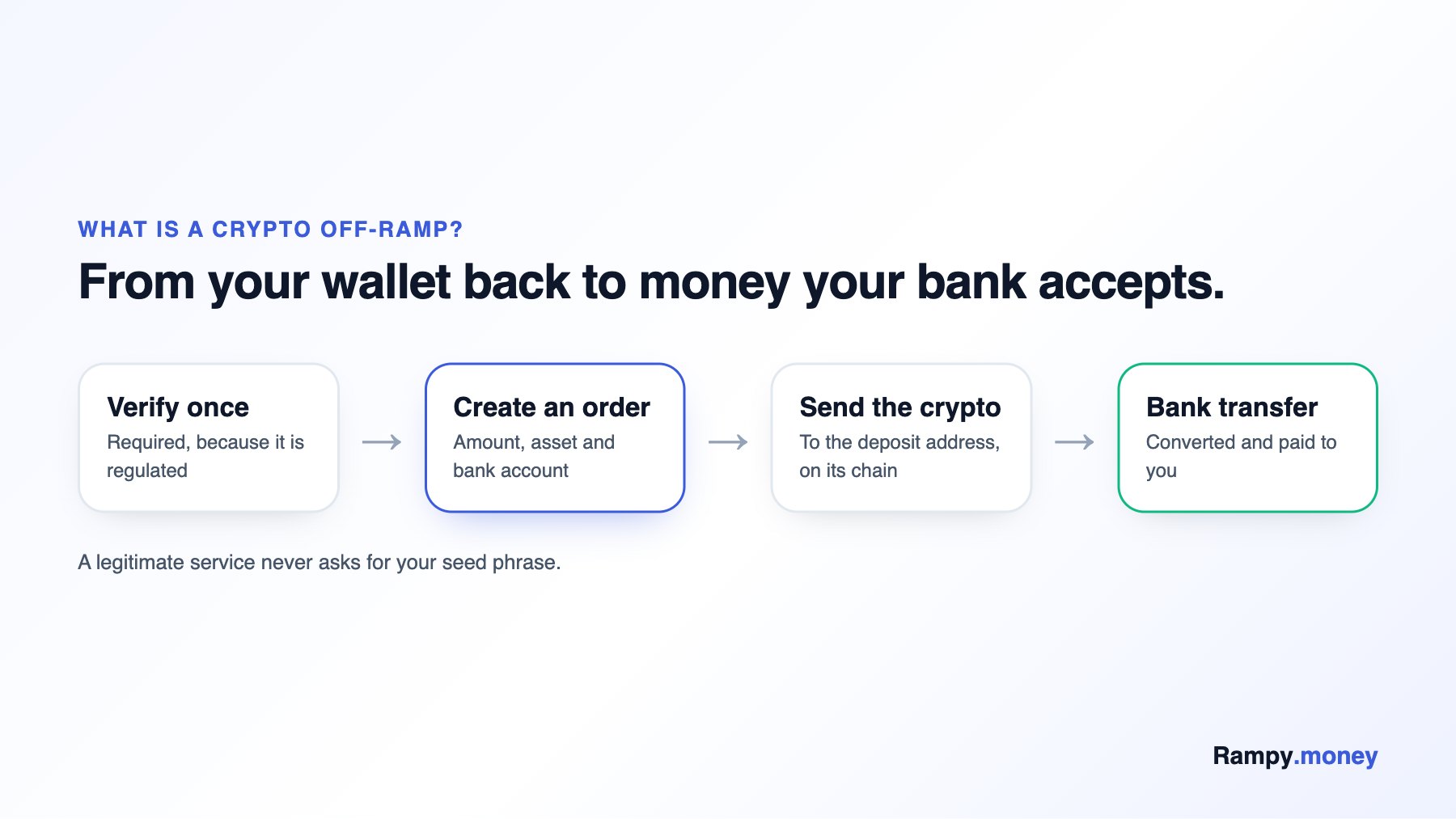
An off-ramp converts cryptocurrency into traditional money and delivers it to a bank account. An on-ramp does the reverse. The terms come from thinking of the crypto economy as a motorway: you need somewhere to get on and somewhere to get off.
What actually happens
- You verify your identity once, because moving money between crypto and banks is regulated.
- You create an order specifying the amount, the asset and the destination bank account.
- The provider gives you a deposit address on a specific blockchain.
- You send the crypto from your wallet to that address.
- The provider converts it and initiates a bank transfer to you.
Steps three and four are where the risk sits. Blockchain transactions are final. Send to the wrong address or the wrong network and no one can reverse it.
Off-ramp versus exchange
An exchange is a marketplace where many people trade many assets, and it holds your funds while you do. An off-ramp does one job: convert and pay out. The practical difference is custody. A good off-ramp never holds your assets for longer than the conversion requires, and a non-custodial one never holds your keys at all.
| Exchange | Off-ramp | |
|---|---|---|
| Purpose | Trading many assets | Converting to bank money |
| Custody | Holds your funds while you trade | Transient, or none |
| Verification | Required | Required |
| Best when | You are actively trading | You self-custody and want cash out |
Why you cannot avoid verification
Converting crypto to bank money is exactly the point where anti-money-laundering law applies. Any provider connected to the banking system must know who its customers are. This is not a business choice they can waive. Services advertising no-KYC conversion at meaningful volume are operating outside the law, and your funds are at risk with them.
Custodial and non-custodial
A custodial service takes your assets into its own wallets. A non-custodial one does not hold your private keys, and funds settle directly to a wallet you control. Non-custodial reduces the risk that a provider's failure takes your money with it, but it puts responsibility for your keys entirely on you. Lose them and nobody can help.
How to spot a legitimate service
- It names the regulated partners that actually move the money.
- It requires identity verification and says so upfront.
- It publishes real fees before you confirm, not after.
- It has terms, a privacy policy and a complaints route.
- It never asks for your seed phrase. No legitimate service ever needs it.
Rampy is a non-custodial off-ramp. Funds move from your wallet to your bank through regulated partners, and we never hold your keys.
Try an off-rampFrequently asked
What is the difference between an on-ramp and an off-ramp?
An on-ramp converts traditional money into crypto. An off-ramp converts crypto back into money in your bank account. Many services do both.
Do all off-ramps require KYC?
Every legitimate one does. Converting crypto to bank money triggers anti-money-laundering obligations. Services claiming otherwise carry serious legal and counterparty risk.
Is a non-custodial off-ramp safer?
It removes the risk of a provider holding and losing your assets, but it makes you fully responsible for your own wallet security. A lost key cannot be recovered by anyone.