Is Converting Crypto to Cash Taxable? What to Record
In most countries the answer is yes, and the surprise is how many other actions also count. Here is what triggers a taxable event and what to record.
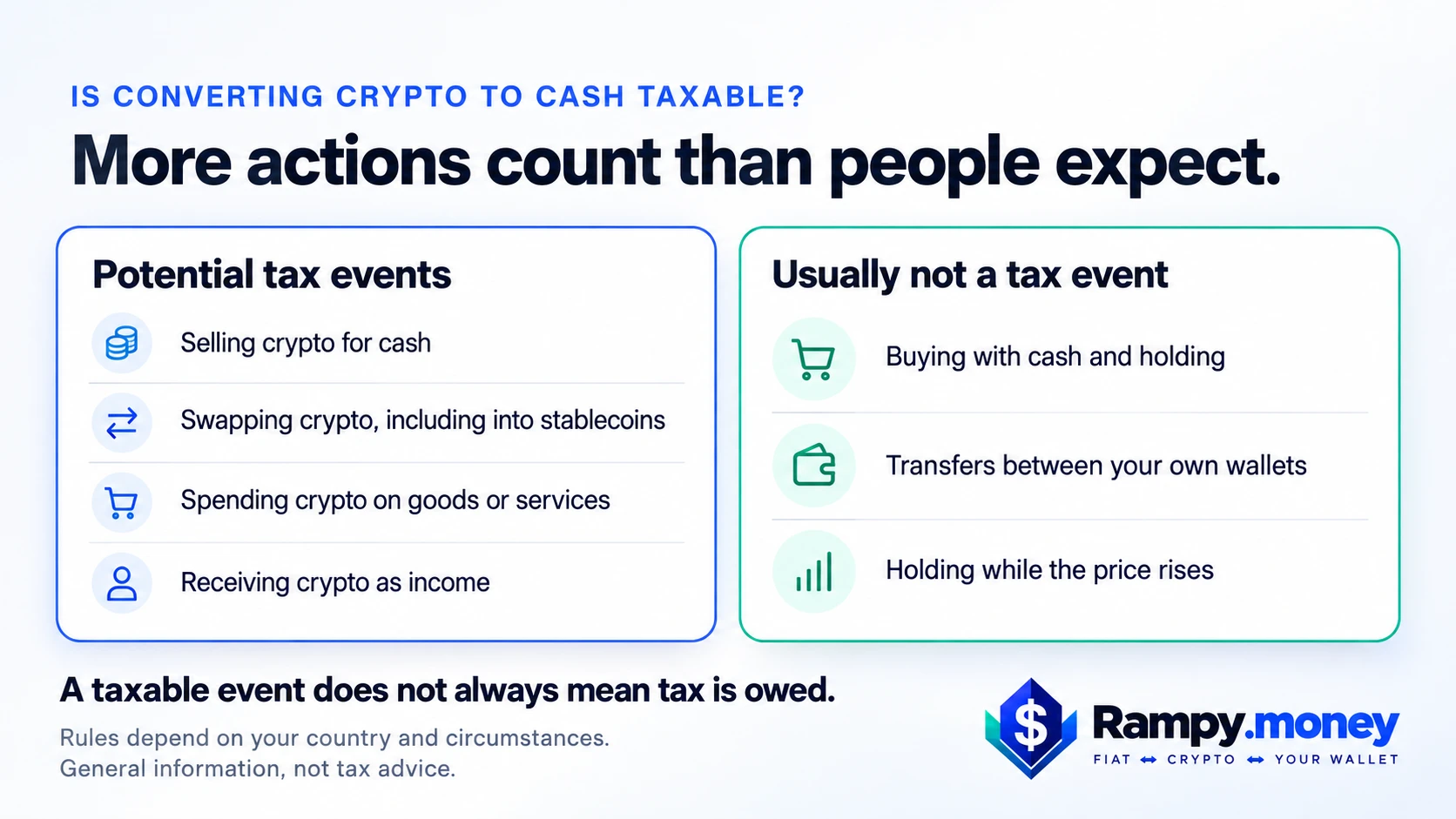
In most jurisdictions, converting cryptocurrency into fiat currency is a disposal. You are treated as having sold an asset, and the difference between what you paid and what you received is a gain or a loss. The awkward part is that far more actions count as disposals than people expect.
What usually counts as a taxable event
- Selling crypto for fiat and withdrawing to your bank.
- Swapping one crypto for another, including into a stablecoin.
- Spending crypto on goods or services.
- Receiving crypto as income, payment or staking rewards, usually taxed as income at receipt.
What usually does not
- Buying crypto with fiat and holding it.
- Moving crypto between wallets you own.
- Holding while the price rises. Unrealised gains are generally not taxed.
Stablecoins are not exempt
A common misconception is that stablecoins avoid tax because their value does not move. The stablecoin leg may produce a negligible gain, but the disposal that got you into it is still reportable, and jurisdictions generally treat stablecoins as property or assets rather than currency.
Roughly how the major regimes treat it
| Region | Treatment | Note |
|---|---|---|
| United States | Property; capital gains apply | Holding over a year usually attracts a lower long-term rate |
| United Kingdom | Capital Gains Tax on disposal | An annual exempt amount applies, and it has been reduced in recent years |
| European Union | Varies by member state | Some states exempt gains after a holding period; others do not |
What to record, at the time
Reconstructing this later from block explorers is genuinely painful. Capture it as you go.
- Date and time of the disposal.
- What you disposed of and how much.
- What you received, in your local currency, at that moment.
- The cost basis, meaning what you originally paid, plus acquisition fees.
- All fees, including provider fees and network fees, which usually reduce the gain.
- Wallet addresses and transaction hashes as supporting evidence.
Losses are worth recording too
If you sold at a loss, that loss can often offset gains elsewhere and sometimes carry forward. People diligently record gains and forget losses, which usually costs them money.
Rampy exports your full transaction history as CSV, with fees and transaction hashes, ready for an accountant.
Export your historyFrequently asked
Do I pay tax if I only convert to a stablecoin?
Usually yes. Swapping one crypto asset for another, including a stablecoin, is generally a disposal of the first asset even though no bank was involved.
Is moving crypto between my own wallets taxable?
Generally no. Transferring between wallets you control is not a disposal, though you should keep records showing both addresses are yours.
Can I deduct fees?
In most regimes acquisition and disposal costs, including provider and network fees, reduce the taxable gain. Keep the receipts.