Tron vs Ethereum for USDT: Which Network Should You Use?
The same token, wildly different costs. Choosing the wrong network can cost twenty dollars on a transfer that should cost one.
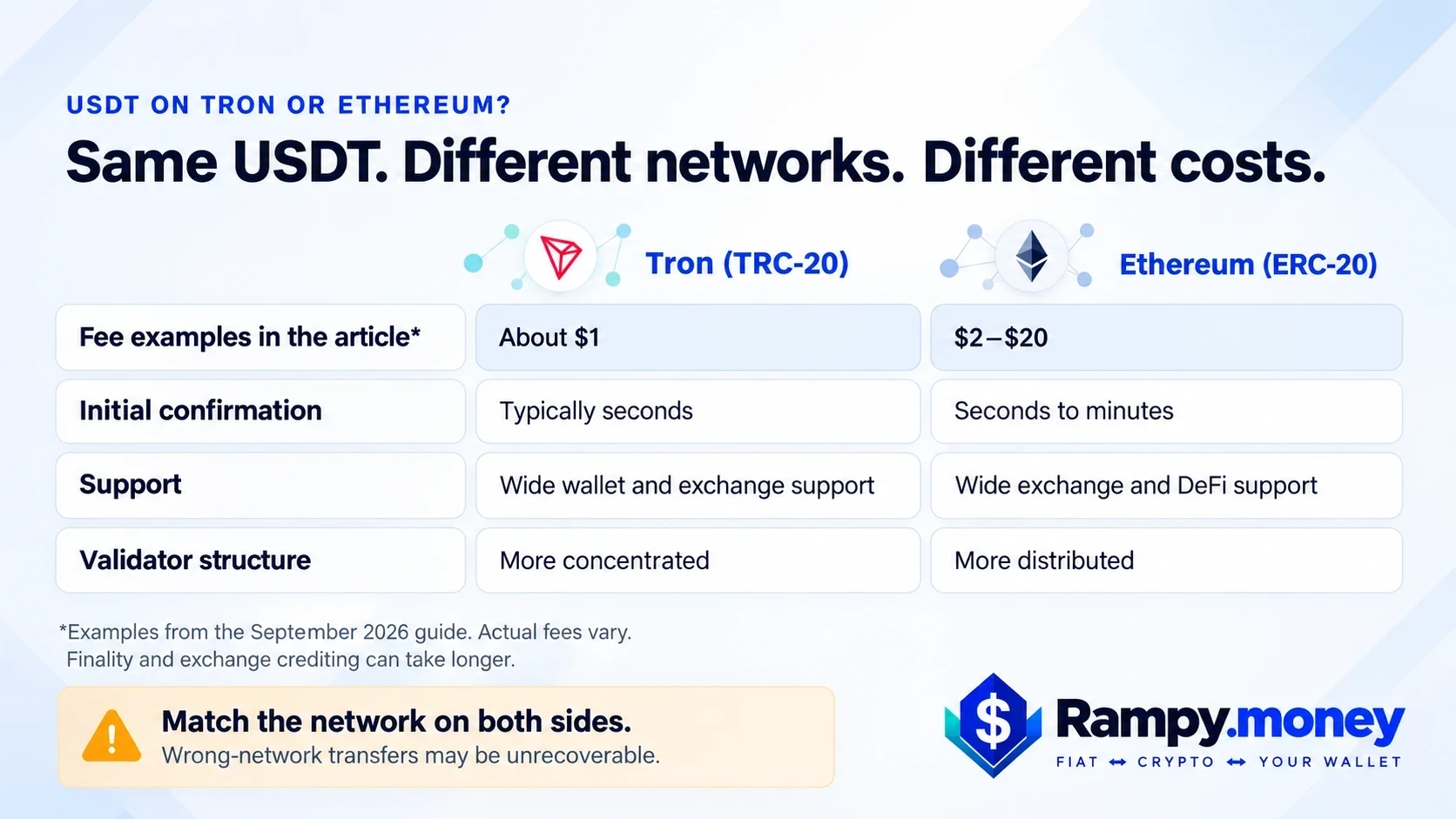
USDT exists on many blockchains. The token is identical in value; the cost of moving it is not. For anyone transferring regularly, this choice matters more than almost anything else in their setup.
The comparison
| Tron (TRC-20) | Ethereum (ERC-20) | |
|---|---|---|
| Typical fee | About $1 | $2–$20, congestion dependent |
| Confirmation | Seconds | Seconds to minutes |
| Support | Very wide, especially in Asia | Universal |
| Decentralisation | More concentrated validator set | Highly decentralised |
| Typical minimum | Often lower | Often higher, to cover fees |
Why Tron dominates USDT transfers
Tron became the default rail for USDT because it is cheap and predictable. When you are moving $200, a one dollar fee is tolerable and a twenty dollar fee is not. Enormous USDT volume settles on Tron for exactly this reason, particularly in remittance corridors.
Why Ethereum still matters
Ethereum has the deepest integration across DeFi, the widest institutional support and a far more decentralised validator set. If you are interacting with DeFi protocols, or you place weight on decentralisation, the higher fee buys something real. For a simple transfer to an off-ramp, it usually does not.
The trade-off nobody mentions
Tron's low fees come from a more concentrated validator set. That is a genuine decentralisation trade-off. For a transfer lasting a few minutes it is a reasonable one. For holding a very large balance long term, some people prefer the more decentralised chain and accept the cost.
Do not forget the alternatives
Solana moves USDT for a fraction of a cent and confirms in under a second. Several Layer 2 networks are similarly cheap. If your provider supports them, they often beat both Tron and Ethereum on cost. The right question is not Tron or Ethereum, but which cheap network both you and your counterparty support.
Practical guidance
- Moving USDT to an off-ramp: use the cheapest network both sides support, usually Tron or Solana.
- Interacting with DeFi: Ethereum or a Layer 2, because that is where the liquidity is.
- Large long-term holdings: weigh decentralisation, not just fees.
- Always send a small test first when the amount matters.
Rampy accepts USDT on Tron, Ethereum and Solana, and shows the minimum for each route before you commit.
Convert USDTFrequently asked
Is USDT on Tron the same as USDT on Ethereum?
The same value, but different tokens on different networks. They are not interchangeable, and sending to an address on the wrong network usually loses the funds permanently.
Why is Tron so much cheaper?
Tron's design and more concentrated validator set allow much lower fees. That is a real decentralisation trade-off, which many people accept for short transfers.
Is there anything cheaper than Tron?
Solana typically costs a fraction of a cent, as do several Layer 2 networks. Whether you can use them depends on what your counterparty supports.