USDC vs EURC: Which Stablecoin Should a European Actually Hold?
Holding a dollar stablecoin while living on euros is a currency bet you may not have realised you were making.
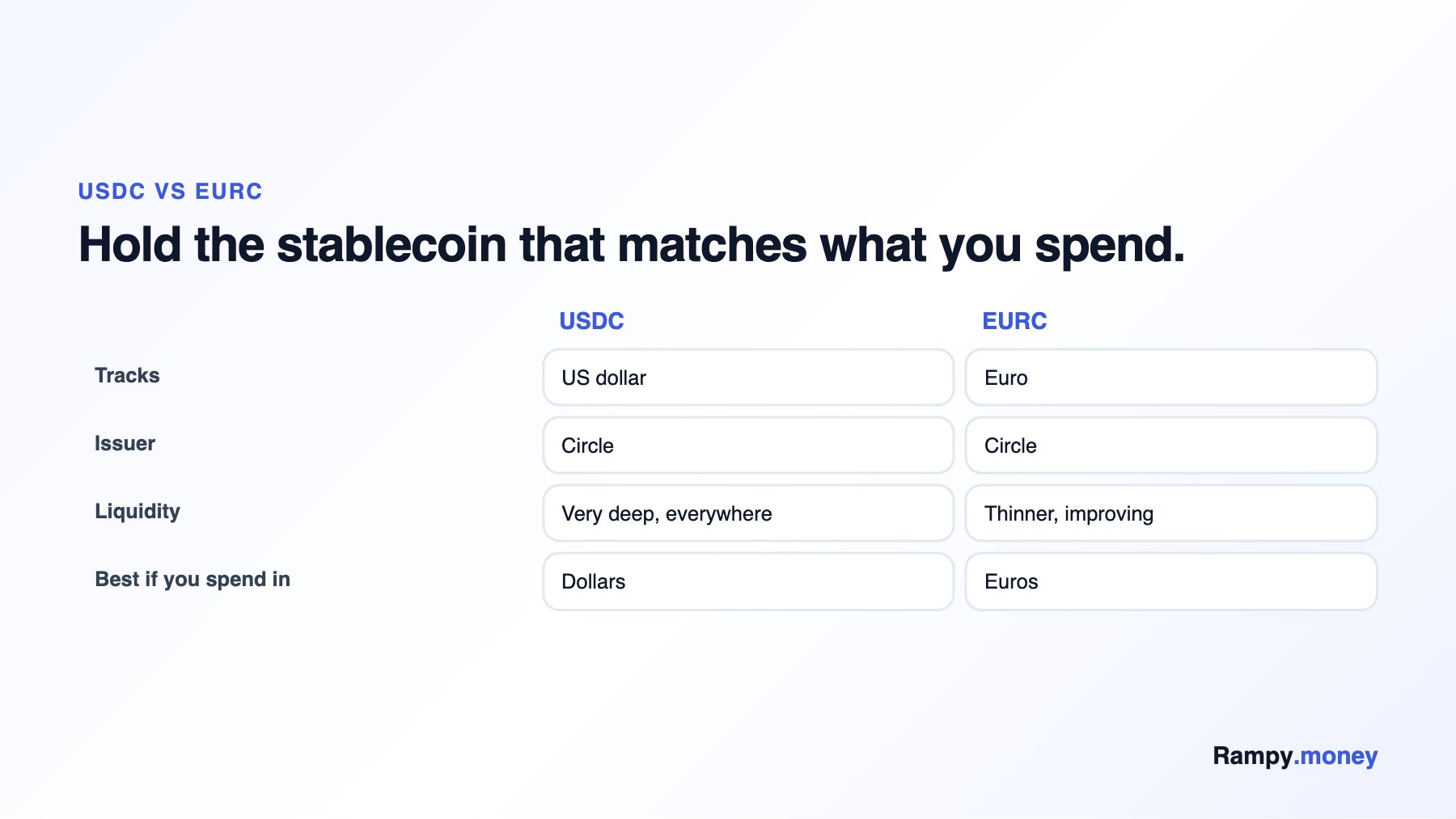
USDC and EURC come from the same issuer, follow the same rules, and are redeemable the same way. The only meaningful difference is which currency they track — and for anyone living in the euro area, that difference is the entire question.
Side by side
| USDC | EURC | |
|---|---|---|
| Tracks | US dollar | Euro |
| Issuer | Circle | Circle |
| Reserves | Cash and short-dated US treasuries | Cash held at European institutions |
| Liquidity | Very deep, everywhere | Thinner, improving |
| Networks we support it on | Ethereum, Base, Polygon, Arbitrum, Optimism, Avalanche, Solana, Stellar | Ethereum, Base, Solana, Stellar |
| Best if you spend in | Dollars | Euros |
The currency bet nobody mentions
If you earn and spend euros but hold USDC, you are exposed to the euro–dollar exchange rate for as long as you hold it. That is not a small thing. EUR/USD has moved more than 10% within a single year more than once in the last decade. A stablecoin is stable against its own currency, not against yours.
Held for a week while you arrange a payment, that exposure barely matters. Held for a year as savings, it is a live position in the foreign exchange market that you did not consciously take.
Where USDC is genuinely better
Liquidity. USDC is accepted almost everywhere in crypto, trades against nearly everything, and moves on more networks. EURC is well built but younger, and there are places that simply do not list it. If you need to move between assets frequently, USDC has fewer dead ends.
It is also cheaper to be wrong about. A thin market means a wider spread, and converting a large amount of a less liquid asset can cost more than the headline fee suggests.
Where EURC is genuinely better
Anything that ends in a euro bank account. If you are converting to EUR over SEPA, holding EURC removes a currency conversion from the journey entirely — you are not selling dollars to buy euros, you are redeeming euros for euros. That saves the spread, and it removes the risk that the rate moves between deciding and settling.
It also simplifies your records. Every conversion of a dollar asset into euros produces a gain or loss in your reporting currency. Converting EURC to EUR usually produces almost nothing to report.
The regulatory point, briefly
Euro-denominated stablecoins issued in Europe sit inside a regulatory framework that dollar tokens issued elsewhere do not. For most individuals this changes nothing day to day. For a business choosing what to hold on its balance sheet, it is worth a conversation with your advisers, because the rules are still settling.
A simple rule
- Hold the stablecoin that matches the currency you spend, for anything you might need soon.
- Hold USDC when you need liquidity, breadth of support, or to move between assets often.
- Do not hold a foreign-currency stablecoin as long-term savings without deciding, deliberately, that you want that exposure.
Rampy converts both USDC and EURC to USD, EUR or GBP for 1.99% + 1.99 below 500, then 0.99% + 1.99 from 500 per order, and can swap between them for 0.5% of the amount, with no flat fee.
Swap USDC and EURCFrequently asked
Is EURC as safe as USDC?
Both are issued by Circle against reserves and redeemable at par. EURC's reserves are held in euros at European institutions. The practical difference is liquidity, not safety.
Should a European hold USDC or EURC?
EURC, for anything you will spend in euros — holding a dollar token while living on euros is an unintended currency bet. USDC when you need the deeper liquidity and wider support.
Can I swap USDC to EURC directly?
Yes, and doing so involves no bank, so there is no fiat processing fee. Note that it is still a disposal of one asset for another in most tax systems, even though both are stablecoins.
Which networks carry EURC?
Fewer than USDC. We support EURC on Ethereum, Base, Solana and Stellar, against eight networks for USDC. Check before you send.