Why Is My Crypto Withdrawal Still Pending?
Pending means different things at different stages, and the difference decides whether you should wait, act, or contact someone.
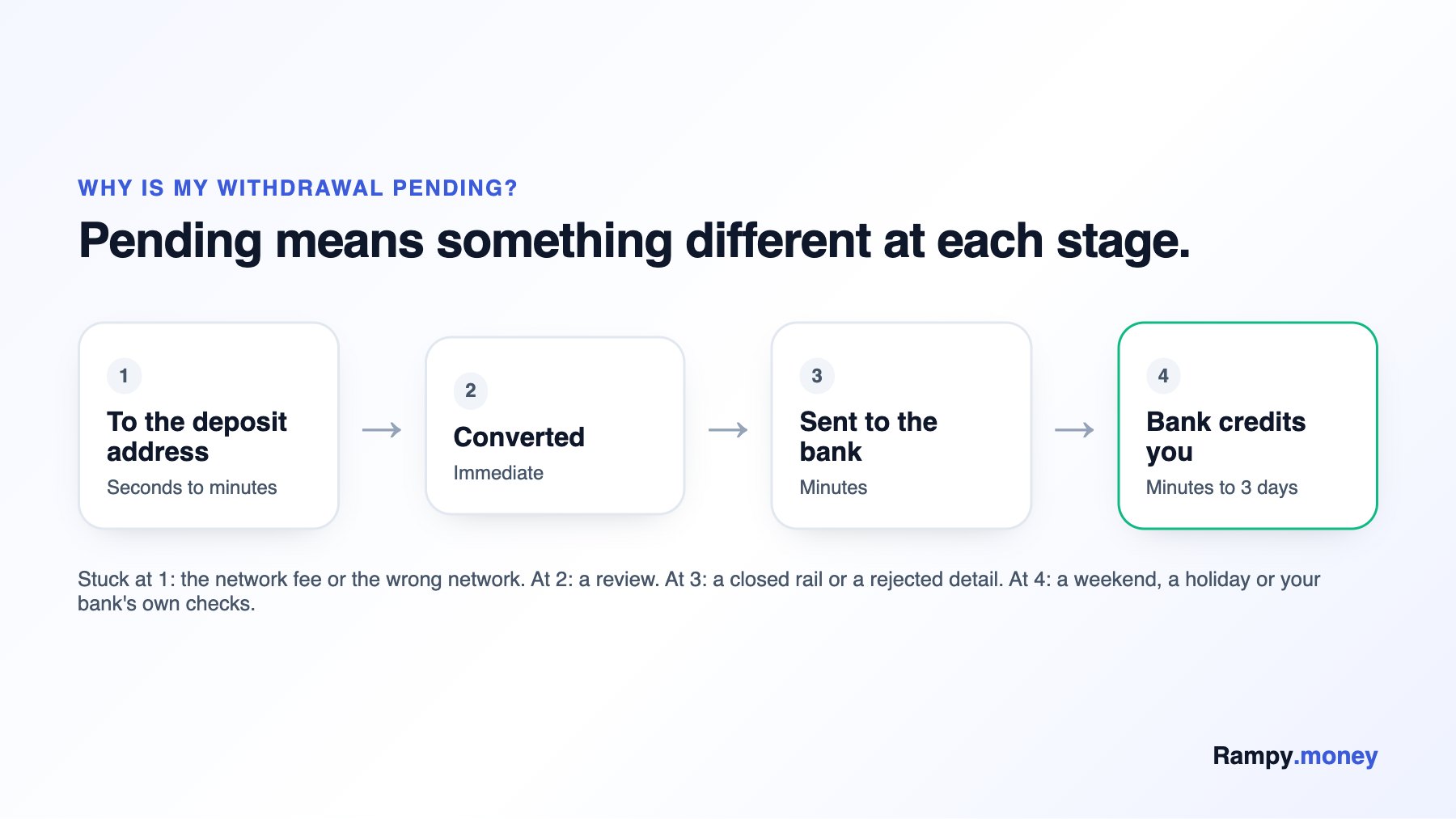
A withdrawal that says pending is not one state. It is at least four, and they have almost nothing in common: waiting for a blockchain, waiting for a bank, waiting for a person, and waiting for you. Working out which one you are in tells you whether to wait quietly or do something.
Where the money actually is
A crypto-to-bank transfer has four legs. Each can hold, and each holds differently.
| Stage | Normal duration | Stuck means |
|---|---|---|
| Your wallet to the deposit address | Seconds to minutes | Underpriced network fee, or wrong network |
| Provider receives and converts | Immediate | Screening or a compliance review |
| Provider submits to the bank | Minutes | Rail closed, or a payout detail rejected |
| Bank credits your account | Minutes to 3 days | Weekend, holiday, or your bank's own checks |
1. The blockchain has not confirmed
If you cannot see the transaction confirmed on a block explorer, nothing downstream has started. On Ethereum a transaction with too low a fee can sit unmined for hours. On Solana, Base or Tron this is rare — those confirm in seconds.
What helps: check the hash on an explorer. If it is confirmed, the delay is not here. If it is not, the fix is at your wallet, not with the provider.
2. It is the weekend
This is the most common answer and the most disappointing one, for some rails. ACH and US wires do not run at weekends or on US bank holidays, and standard SEPA keeps business days. A Friday-evening sale on those commonly credits on Monday or Tuesday, and no part of that is broken.
Other rails ignore the calendar. SEPA Instant runs every day, and our partner sends euros that way whenever the receiving bank takes it. Faster Payments in pounds, Pix in reais and SPEI in pesos run seven days a week; SPEI pauses for up to two hours on Thursday mornings (06:00 to 08:00 UTC) for our partner's bank maintenance. If speed matters and you have the choice of rail, pick one of those.
3. Something needs a person
Regulated providers screen transactions. Most pass invisibly. Some do not, and then a human has to look — because the amount is much larger than your history, because the sending wallet has a flag against it, or because a verification document expired between signing up and selling.
What helps: answer any request quickly and completely. What does not help: sending the same question through three channels, which usually adds a queue rather than removing one.
4. A payout detail was rejected
The bank details were accepted when you added them and rejected when money was actually sent. A closed account, a mistyped digit, a name that does not match. The money is not lost — a rejected payout comes back to the provider — but it does mean the transfer has to be set up again once the details are fixed.
5. Your own bank is holding it
The last leg is out of the provider's hands. Some banks hold a first incoming payment from an unfamiliar source, especially where the sender is a payments institution rather than a person. Some ask what it is for. This is your bank's decision and only you can answer it.
6. You are looking for the wrong name
The credit will arrive from the licensed institution that operates the rail, not from the brand of the app you used. People scan their statement for a familiar name, do not see it, and conclude nothing arrived. Match on the amount and the reference instead.
What to do, in order
- Find the transaction hash and confirm it on a block explorer.
- Check whether a weekend or bank holiday sits between now and when you sent it.
- Look at the order's own status page, which usually names the stage.
- Check your bank statement for the amount rather than the name.
- Only then contact support — with the order id and the hash, which turns a conversation into an answer.
Rampy shows the live stage of every order, emails you when it changes, and keeps the transaction hash on the order so you never have to hunt for it.
Check your orderFrequently asked
How long should a crypto-to-bank transfer take?
Minutes on Faster Payments, same or next business day on SEPA, one to three business days on ACH. The crypto leg is usually the fastest part; the bank leg dominates.
Does a pending transfer mean my money is lost?
Almost never. Money in a pending transfer is either on the blockchain, with the provider, or in a bank's queue. The exception is sending on a network that was not supported, which is not a pending transfer at all.
Can I speed up a pending withdrawal?
Only if the delay is at your end — a low network fee you can replace, or a document you have not supplied. Bank rails and weekends cannot be hurried, and contacting support repeatedly does not move a queue.
Why is the sender's name not the company I used?
Because a licensed institution operates the payout rail and their name appears on the statement. Match your payment on the amount and the reference.