SEPA vs SWIFT for Crypto Payouts: Which Rail Gets You Paid
Two ways to move euros, and the difference is not speed alone. One has a predictable cost; the other has fees you find out about afterwards.
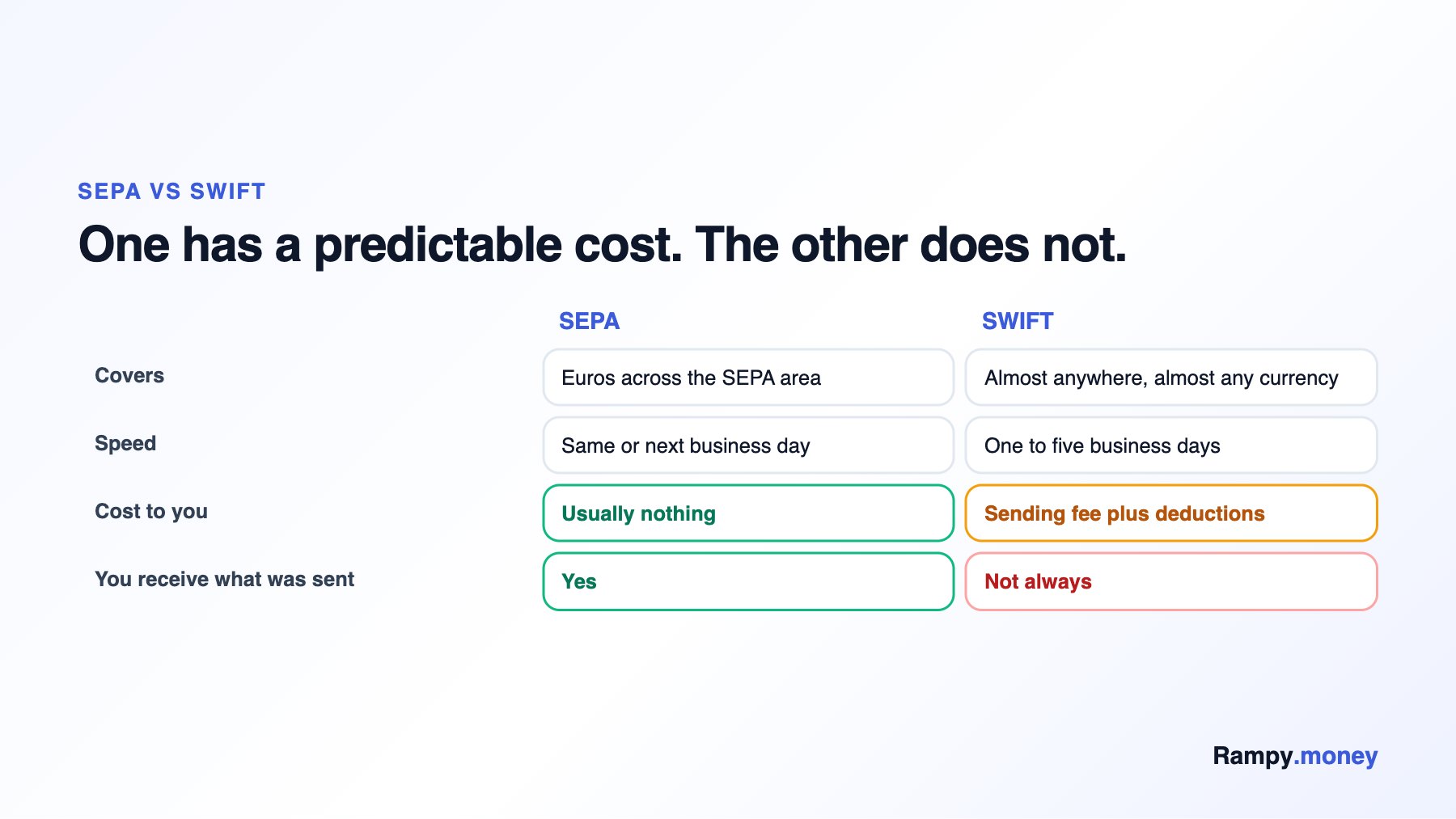
When a provider pays out euros, it uses SEPA. When money crosses currency zones, it usually uses SWIFT. People treat these as the same thing at different speeds. They are not: they are different systems with different cost structures, and the one that surprises you is SWIFT.
The difference in one table
| SEPA | SWIFT | |
|---|---|---|
| Covers | Euro payments across the SEPA area | Almost anywhere, almost any currency |
| Speed | Same or next business day | One to five business days |
| Cost to you | Usually nothing, or a small flat fee | Sending fee plus correspondent deductions |
| Predictable | Yes — you receive what was sent | No — intermediaries can deduct |
| Weekends | No | No |
The correspondent bank problem
SWIFT is not a payment network. It is a messaging network: banks send each other instructions, and the money moves through a chain of correspondent banks that each hold accounts with the next. Every bank in that chain can take a fee, and those fees are deducted from the payment in transit.
This is why an international wire arrives short. Nobody told you about the deduction because the deducting bank has no relationship with you at all. On a small payment, two intermediaries taking $15 each is a serious proportion.
Why SEPA is predictable
SEPA was built to make a euro payment between countries behave like a domestic one. There is no chain of intermediaries taking a cut, the amount that leaves is the amount that arrives, and by regulation a cross-border euro payment inside the area cannot cost more than a domestic one. That is the whole point of it.
For crypto payouts this matters more than the speed difference. A predictable cost lets a provider quote you a total that is actually the total.
What this means when you cash out
- If you hold a euro bank account in the SEPA area, take the euro payout. It is faster and the amount is certain.
- Converting to dollars and receiving a wire because you think dollars are more standard is usually a worse deal, because you pay a currency conversion and then correspondent fees.
- If you must receive across currencies, ask who bears the charges before it is sent.
And the third option people forget
SEPA Instant credits in seconds and runs at weekends, but not every bank supports receiving it and not every provider offers it. In the UK, Faster Payments does the same job and is close to universal, which is why GBP payouts are usually the quickest of the three major currencies.
| Rail | Currency | Typical arrival |
|---|---|---|
| Faster Payments | GBP | Minutes, weekends included |
| SEPA | EUR | Same or next business day |
| ACH | USD | One to three business days |
| Domestic wire | USD | Often same business day |
| SWIFT international | Various | One to five business days, minus deductions |
Rampy pays out over SEPA, Faster Payments, ACH and domestic wire, quoted in full before you confirm at 1.99% + 1.99 below 500, then 0.99% + 1.99 from 500 per order.
See your payout optionsFrequently asked
Why did my international wire arrive short?
Correspondent banks in the chain deducted fees in transit. They have no relationship with you and did not tell you. Asking the sender to use the OUR charge code prevents it.
Is SEPA free?
To you, usually. Regulation requires a cross-border euro payment within the SEPA area to cost no more than a domestic one, and most banks charge nothing to receive.
Which is fastest for a crypto payout?
GBP over Faster Payments, typically minutes and available at weekends. SEPA is same or next business day; ACH is one to three.
Should I take dollars if I bank in euros?
Usually not. You would pay a currency conversion and then potentially correspondent fees. Take the payout in the currency of the account receiving it.