Source of Funds: Why a Crypto Provider Is Asking, and What to Send
It feels like an accusation. It is not one. Understanding what is being asked turns a week-long hold into a same-day answer.
At some point a regulated provider will ask where your money came from. It reads as suspicion, and people react accordingly — they get annoyed, they answer vaguely, or they ignore it. All three make the hold last longer. Understanding what is actually being asked usually turns it into an afternoon's work.
Two different questions
| Asks about | Typical evidence | |
|---|---|---|
| Source of funds | This specific money | The trade, the invoice, the sale, the payslip |
| Source of wealth | Your overall financial position | Employment, business ownership, inheritance, investments |
Most requests are the first. The second comes up for large amounts or where the first answer does not explain the scale of what is moving.
Why they have to ask
Anti-money-laundering law obliges regulated firms to understand their customers' transactions, and to be able to demonstrate to a supervisor that they did. It is not discretionary and there is no version of the service that skips it. A provider that never asks anyone anything is either very small, very new, or in trouble.
The trigger is usually pattern rather than suspicion: an amount much larger than your history, a first transaction that is unusually big, funds arriving from a wallet with a flagged history, or a country on a heightened-risk list.
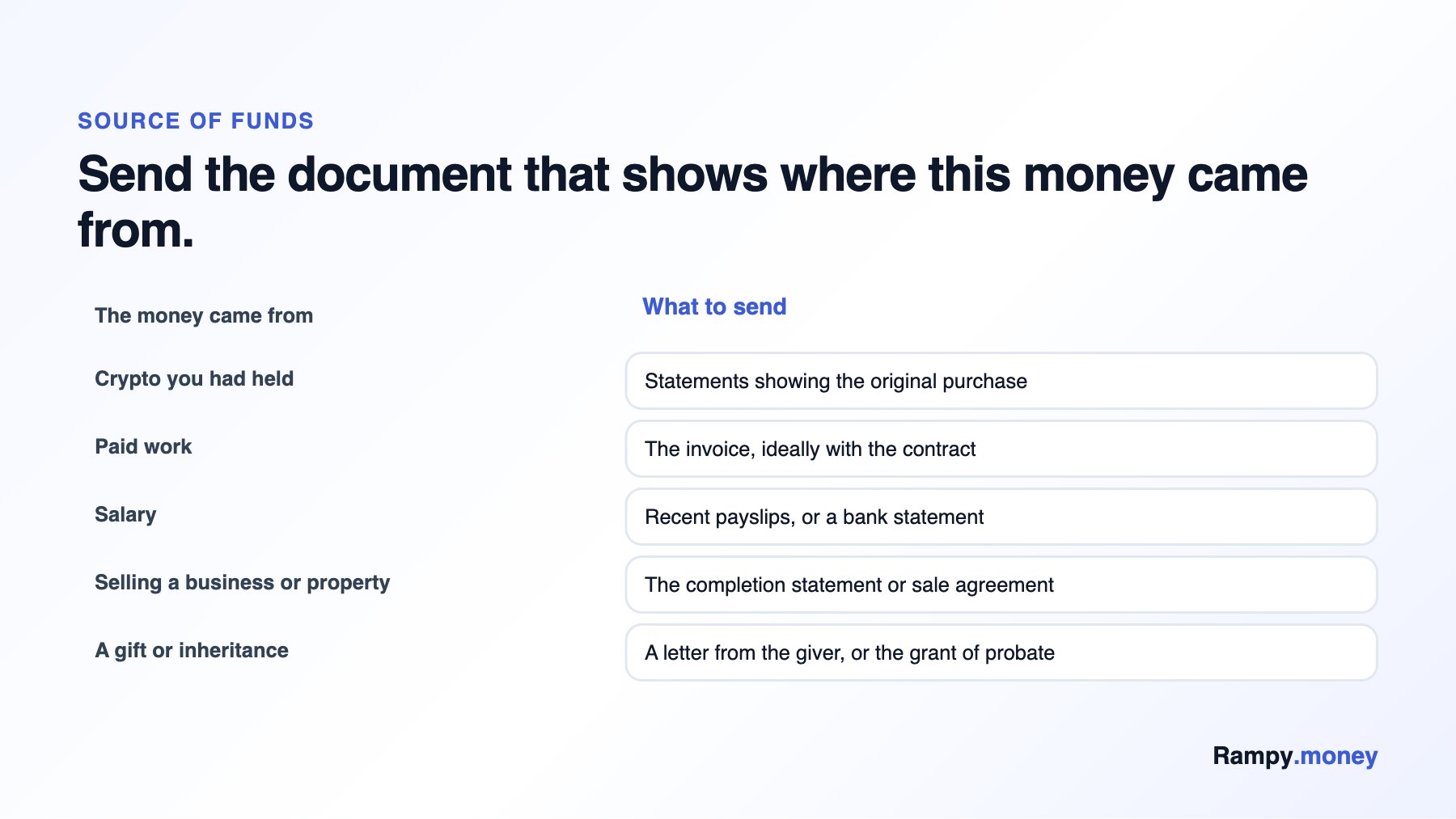
What to send
Documents beat explanations. A paragraph describing where the money came from is a claim; a document is evidence. Send the strongest thing you have.
- Sold crypto you had held: exchange statements or transaction history showing the original purchase.
- Paid for work: the invoice, and ideally the contract or engagement letter.
- Salary: recent payslips, or a bank statement showing the credits.
- Sold a business or property: the completion statement or sale agreement.
- A gift or inheritance: a letter from the giver, or the grant of probate.
- Mining or staking: the pool statements or on-chain reward history.
What makes it slower
- Answering in prose with no documents attached.
- Sending a screenshot cropped so tightly that the name and date are missing.
- Explaining a large sum with evidence for a small part of it and hoping nobody notices.
- Arguing about whether the request is justified. The reviewer cannot waive a legal obligation, however reasonable your objection.
- Going quiet. An unanswered request eventually becomes a closed account, and closed accounts are much harder to reopen than open ones.
What happens to what you send
It is kept. Financial regulations require records to be retained for years after the relationship ends — commonly five — so a request to delete your documents immediately afterwards cannot usually be granted in full. That is a legal obligation on the firm rather than a preference, and any provider's privacy policy should say so plainly. If yours does not mention retention at all, that is worth noticing.
Getting ahead of it
The best time to assemble this is before you need it. If you are planning to convert a large amount, gather the paperwork first — the purchase records, the invoice, the sale agreement. A request answered within an hour rarely delays anything. One answered in a week delays everything by a week.
Rampy tells you exactly which documents verification still needs, in plain words rather than reference codes, and emails you when something changes.
Check your verificationFrequently asked
Can I refuse a source-of-funds request?
You can, and the provider will generally be unable to proceed. The obligation sits on them, not on you, and they cannot waive it. Refusing usually ends in a closed account rather than a completed transfer.
Does being asked mean I am suspected of something?
No. Most requests are triggered by patterns — an unusually large amount, a first transaction out of line with your history — not by any belief about you. It is a routine control.
How long does a source-of-funds review take?
Hours to days, driven mostly by how complete your first response is. Documents attached at the outset avoid a second round of questions, which is what turns a day into a week.
Will my documents be deleted afterwards?
Not immediately. Anti-money-laundering rules require records to be kept for years after the relationship ends, commonly five, so a deletion request cannot usually be met in full until that period expires.