How to Cash Out Crypto to Your Bank Account in 2026
Buying crypto takes two minutes. Getting it back out, into a bank account your landlord accepts, is where people discover the process is not symmetrical.
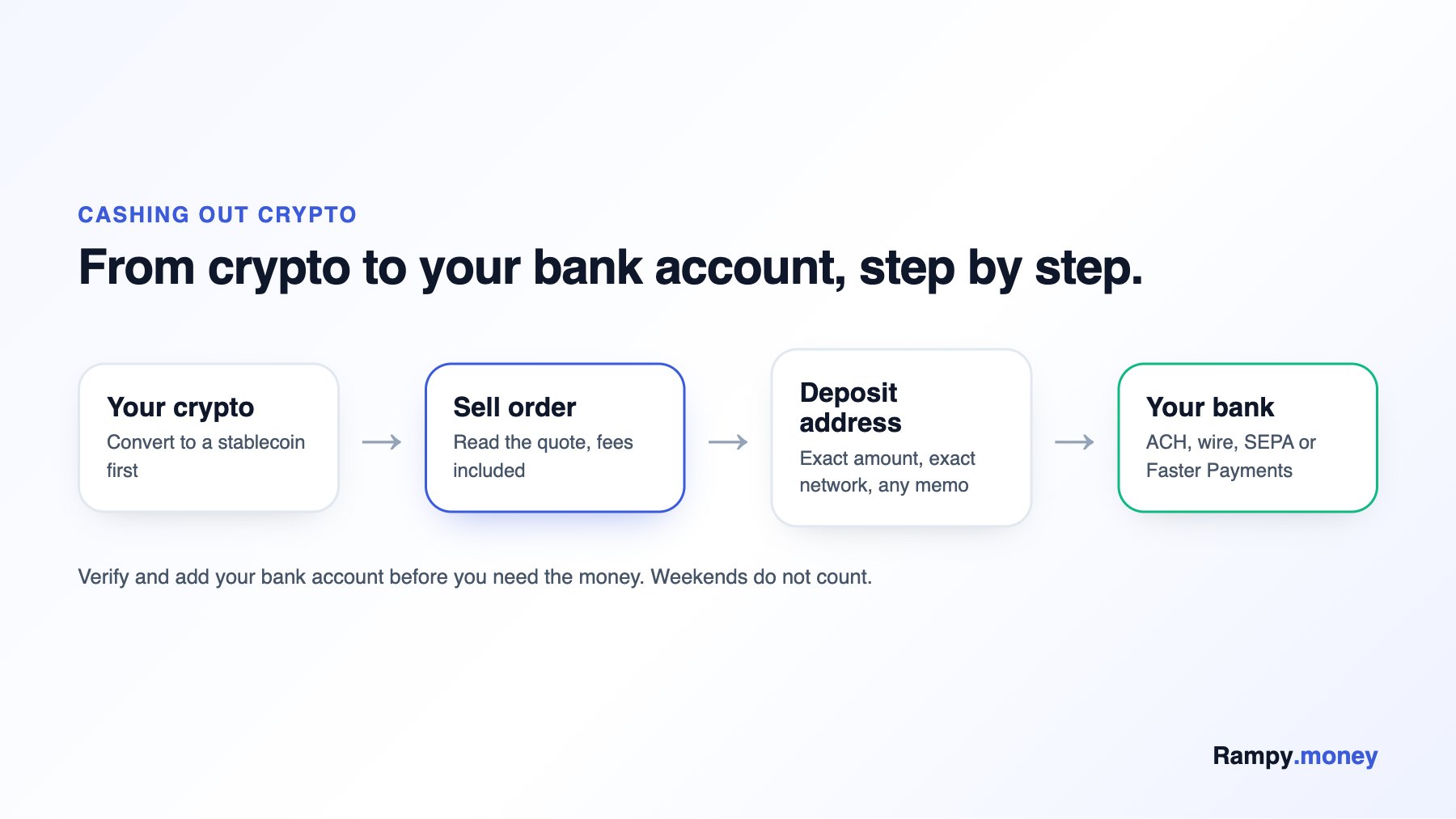
Getting money into crypto is frictionless by design. Getting it out is not, and that asymmetry is deliberate: the moment digital assets touch the banking system, anti-money-laundering rules apply. This guide walks the whole path, including the parts that go wrong.
Convert to a stablecoin first
If you hold Bitcoin, Ethereum or anything volatile, your first step is almost always to convert into a stablecoin such as USDC or USDT. There are two reasons. Off-ramps support far more stablecoin routes than volatile assets, and it removes price risk while the bank transfer settles. A three-day ACH transfer is a long time to be exposed to a falling market.
Choose how the money reaches your bank
| Rail | Currency | Speed | Notes |
|---|---|---|---|
| ACH | USD | 1–3 business days | Cheapest US option, slowest |
| Domestic wire | USD | Often same day | Faster, banks often charge to receive |
| SEPA | EUR | Same or next day | Standard across the eurozone |
| Faster Payments | GBP | Minutes to hours | UK only |
Your provider decides which of these it supports. Match the rail to the currency of the account receiving the money, or you will pay an FX conversion you did not plan for.
Verify before you are in a hurry
Every regulated route requires identity verification. Automated checks usually clear in under a minute, but a manual review can take a business day, and business accounts take longer because ownership has to be established. Complete this while nothing is pending.
The actual steps
- Complete identity verification and wait for approval.
- Add your bank account and let the provider validate it.
- Convert volatile holdings into a stablecoin.
- Create the sell order and read the quote, including fees.
- Send the exact amount to the deposit address given, on the exact network specified.
- Include any memo or reference. Missing references are the top cause of delayed payouts.
- Wait for the bank rail. Weekends do not count.
Why payouts get held
A hold is usually one of five things, and knowing which saves you a support ticket.
- The reference was missing, so the deposit could not be matched to your order.
- The amount did not match the order, which some providers treat as a mismatch requiring review.
- Funds came from an address flagged by blockchain analytics.
- The receiving bank rejected the payment, often a name mismatch.
- A routine compliance review, which the provider may be legally barred from explaining.
Keep records as you go
In most countries converting crypto to fiat is a disposal, and therefore a taxable event. You will want the date, the amount, the rate, the fees and the destination. Reconstructing this a year later from block explorers is miserable. Export your history when you make the transaction, not in April.
Rampy sends funds straight from your wallet to your bank for 1.99% + 1.99 below 500, then 0.99% + 1.99 from 500 per order, and exports your full history as CSV for tax time.
Cash out cryptoFrequently asked
How long does it take to cash out crypto?
The crypto leg confirms in minutes. The bank leg decides the total: same day for a domestic wire, one to three business days for ACH, same or next day for SEPA. Weekends and bank holidays do not count.
Can I cash out to someone else's bank account?
Many providers refuse, and some close accounts for trying. Rampy allows it: you add the account as somebody else's and give the holder's name and address, which our payment partner sends with each payment, and each payment has a limit that is lower while the account is new.
Do I pay tax when I cash out crypto?
In most jurisdictions converting crypto to fiat is a disposal and may create a capital gain or loss. Rules vary, so keep records and speak to an accountant about your situation.