USDC vs USDT: Which Stablecoin Should You Actually Hold?
Both claim to be worth a dollar. They differ in who backs that claim, who regulates them, and what happens if something goes wrong.
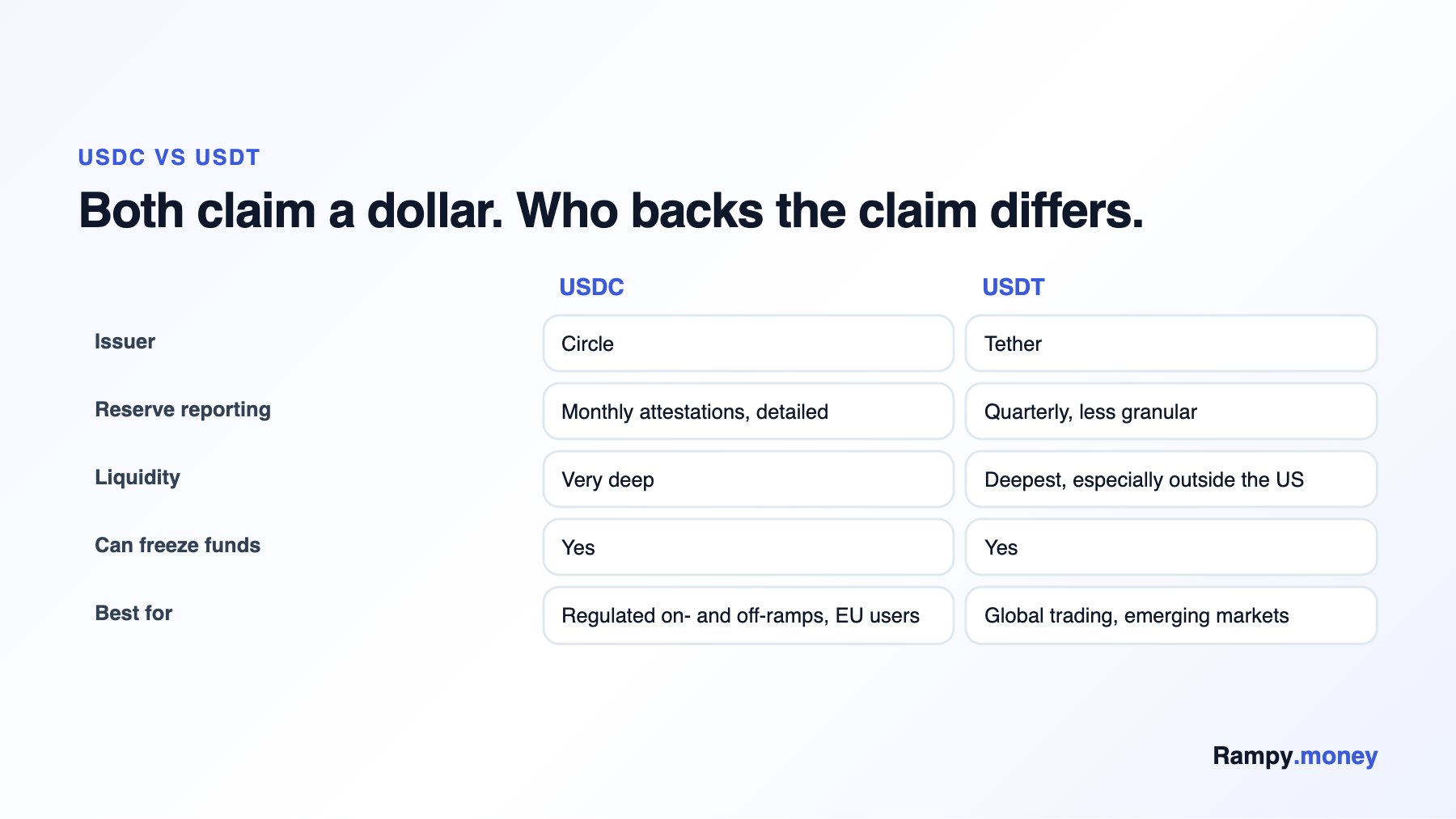
USDT and USDC together account for the overwhelming majority of stablecoin activity. Both aim to hold a dollar's value. The differences are in governance, transparency and where each is actually usable, and those differences matter more than the price chart suggests.
The short version
| USDC | USDT | |
|---|---|---|
| Issuer | Circle | Tether |
| Regulatory posture | US and EU regulated, MiCA compliant | Broader offshore footprint |
| Reserve reporting | Monthly attestations, detailed | Quarterly attestations, less granular |
| Liquidity | Very deep | Deepest, especially outside the US |
| Freeze capability | Yes | Yes |
| Best for | Regulated on and off-ramps, EU users | Global trading, emerging markets |
Reserves and transparency
USDC is issued by Circle, holds reserves in cash and short-dated US Treasuries, and publishes monthly attestations with meaningful detail. USDT is issued by Tether, which publishes quarterly attestations covering a broader mix of assets. Tether has faced regulatory scrutiny over historical reserve disclosures and has since increased reporting. Both are attestations by an accounting firm rather than full audits.
Both can freeze your funds
This is the fact most holders miss. Both issuers can freeze tokens at specific addresses, and both have done so, usually at the direction of law enforcement. Holding a stablecoin is not the same as holding cash. If your address is frozen, the tokens remain in your wallet and become unusable.
Peg stability in practice
Both have deviated from a dollar under stress. USDC fell to about $0.87 in March 2023 when part of its reserves sat at Silicon Valley Bank, recovering once the deposits were guaranteed. USDT has had briefer deviations during periods of doubt. The lesson is not that one is safe and the other is not, but that a peg is a promise supported by reserves and market confidence, and both can wobble.
Where each is actually usable
USDC has broader support among regulated payment providers and, since MiCA, a stronger position in the EU. Some European platforms now support only USDC and EURC for that reason. USDT has deeper liquidity globally, dominates in emerging markets, and is often the only practical option on Tron for low-cost transfers.
Network fees differ, and it matters
The same token costs wildly different amounts to move depending on the chain. USDT on Tron costs about a dollar; on Ethereum it can cost twenty when the network is busy. USDC on Base or Solana costs cents. If you move funds often, the chain matters more than the choice of token.
So which should you hold?
- Cashing out through regulated services, or based in the EU: USDC is the smoother path.
- Trading globally or operating in emerging markets: USDT has deeper liquidity and wider acceptance.
- Holding a large balance for a long period: consider splitting across both rather than concentrating issuer risk.
- Moving funds frequently: choose based on the cheapest supported network, not the token.
Rampy converts USDC, USDT, EURC and PYUSD to USD, EUR, GBP, BRL or MXN across nine networks, for 1.99% + 1.99 below 500, then 0.99% + 1.99 from 500 per order.
Convert stablecoinsFrequently asked
Is USDC safer than USDT?
USDC has more detailed reserve reporting and a stronger regulated posture, particularly in the EU. Neither is insured, and both issuers can freeze addresses, so neither is risk free.
Can USDC or USDT lose their peg?
Yes, and both have. USDC fell to roughly $0.87 in March 2023 during the Silicon Valley Bank failure before recovering. A peg depends on reserves and confidence, not a guarantee.
Which is cheaper to send?
It depends on the network, not the token. USDT on Tron is about a dollar, USDC on Solana or Base costs cents, and anything on Ethereum can cost far more during congestion.