How to Convert USDT to USD and Get It Into Your Bank Account
Tether is the most traded stablecoin in the world, and turning it back into spendable dollars is where most people get stuck. Here is every route, honestly costed.
USDT is easy to acquire and surprisingly awkward to spend. It moves across blockchains in seconds, but the moment you want ordinary dollars in an ordinary bank account, you hit a wall of exchanges, verification queues and fees that are rarely quoted upfront. This guide covers every realistic route, what each actually costs, and the errors that permanently lose funds.
The four routes, and who each suits
Every method of turning USDT into USD is a variation on four approaches. They differ mainly in who takes custody of your money and for how long.
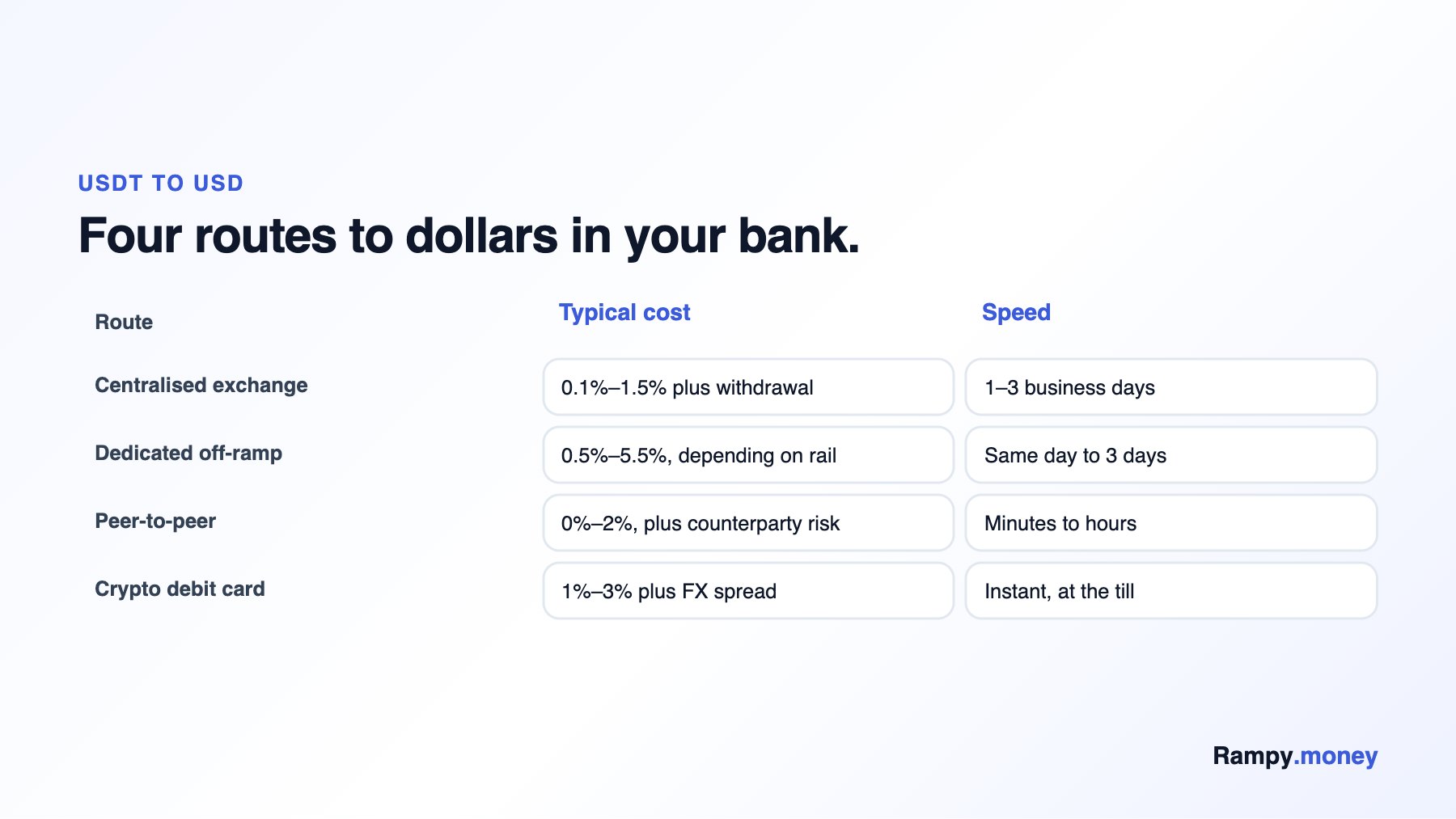
| Route | Typical cost | Speed | Best for |
|---|---|---|---|
| Centralised exchange | 0.1%–1.5% plus withdrawal fee | 1–3 business days | People already holding funds on that exchange |
| Dedicated off-ramp | 0.5%–5.5% depending on rail | Same day to 3 days | Holding in your own wallet, want it in your bank |
| Peer-to-peer | 0%–2%, plus counterparty risk | Minutes to hours | Regions with limited banking access |
| Crypto debit card | 1%–3% plus FX spread | Instant at point of sale | Spending rather than banking |
1. Centralised exchange
Deposit USDT to Coinbase, Kraken or similar, sell into USD, then withdraw by bank transfer. If your funds already sit on that exchange this is usually the cheapest path, often 0.1% to 1.5% all in. The trade-offs are real, though. You hand custody to the exchange while it holds your money, withdrawals can be frozen during a compliance review, and you need a fully verified account before you start.
2. Dedicated off-ramp
You send USDT straight from your own wallet, and dollars land in your bank. Nothing sits on an exchange. This is what services like Rampy do, and it suits anyone who self-custodies. Costs vary widely by provider, from around 0.5% up to 5.5% on instant card payouts, so compare before committing.
3. Peer-to-peer
You sell directly to another person, usually with the platform holding funds in escrow. Fees can be near zero and it works in places where banking rails are limited. The counterparty risk is genuine, and receiving funds from a stranger's account can attract questions from your own bank.
4. Crypto debit card
Not a bank transfer at all, but worth mentioning: you spend the balance directly. Convenient for everyday purchases, poor for moving a large sum into savings, and the FX spread is often hidden.
The network you choose changes the cost
USDT exists on many blockchains, and they are not interchangeable. Sending on the wrong one is the single most common way people lose money in this process.
| Network | Typical transfer fee | Notes |
|---|---|---|
| Tron (TRC-20) | Around $1 | Cheapest and most widely supported for USDT |
| Ethereum (ERC-20) | $2–$20 depending on congestion | Most widely accepted, most expensive |
| Solana | Cents | Fast and cheap, slightly less universal support |
What it actually costs
Providers quote fees in ways that are hard to compare. Watch for three separate charges: the provider's percentage, a fixed fee per payout, and the network fee for moving the coins. A 1% rate with a $3.99 fixed charge is expensive on a $200 payout and cheap on a $5,000 one.
There is also the spread. Some services quote a rate slightly worse than the market rate and take the difference silently. A stablecoin should convert close to 1:1, so a quote materially below that is a fee by another name.
Why verification is unavoidable
Any regulated service converting crypto to bank money must verify who you are. That is anti-money-laundering law, not a preference. Expect to provide a government ID, a selfie check and sometimes a tax identification number. Services advertising no-KYC conversion at meaningful size are either operating outside the law or are outright scams.
Verification usually takes under a minute when automated. Manual review adds a business day. Do it before you need the money rather than during.
How long it takes
- Blockchain confirmation: seconds to a few minutes
- Conversion by the provider: usually immediate
- Domestic wire: often same business day
- ACH transfer: one to three business days
- SEPA transfer: same or next business day
Weekends and bank holidays do not count. A Friday evening sale commonly lands on Tuesday.
Mistakes that cost people money
- Sending on the wrong network. The most expensive mistake, and it is not recoverable.
- Omitting a required memo or reference. Some chains and most bank transfers need one to match your payment. Without it, funds sit unmatched.
- Sending below the minimum. Small amounts can cost more to move than they are worth and may not be returned.
- Assuming the quoted rate is final. Confirm whether network fees are included.
- Leaving it on an exchange. Funds on an exchange are the exchange's liability, not your property. Withdraw once converted.
A practical sequence
- Verify your identity first, before you need the money.
- Add and confirm your bank account.
- Check which networks your provider supports for USDT.
- Send a small test amount first if the sum matters.
- Confirm the reference or memo is included exactly as given.
- Keep the receipt. Converting is usually a taxable event.
Rampy converts USDT to USD, EUR, GBP, BRL or MXN for 1.99% + 1.99 below 500, then 0.99% + 1.99 from 500 per order, with funds settling straight to your bank. Non-custodial, so we never hold your coins.
Convert USDT nowFrequently asked
What is the cheapest way to convert USDT to USD?
If your funds already sit on a major exchange, selling there and withdrawing is usually cheapest at roughly 0.1% to 1.5%. If you hold in your own wallet, a dedicated off-ramp avoids exchange deposit steps and custody risk, typically for 0.5% to 2%.
Can I convert USDT to USD without KYC?
Not at meaningful size through any regulated service. Converting crypto to bank money triggers anti-money-laundering obligations everywhere. Services promising otherwise carry serious legal and counterparty risk.
Which network is cheapest for sending USDT?
Tron is usually around a dollar and Solana costs cents. Ethereum is the most widely supported but can cost $20 when the network is busy. Always confirm your recipient supports the network first.
How long does USDT to bank take?
The crypto side confirms in minutes. The bank side dominates: same day for a domestic wire, one to three business days for ACH, and same or next day for SEPA.