I Sent Crypto on the Wrong Network. Is It Gone?
The answer depends on one thing: whether anyone controls the private key for that address on the chain you used.
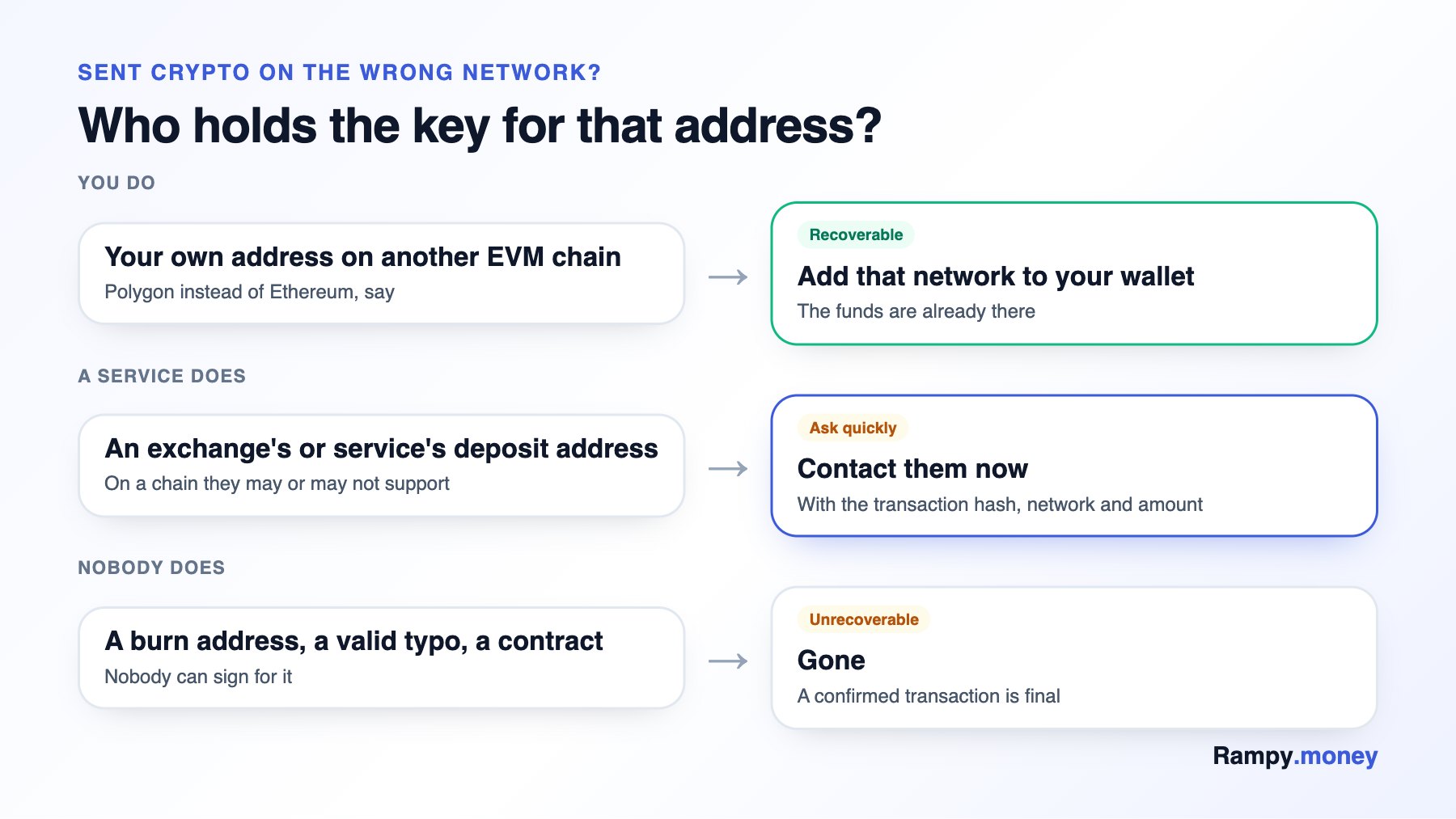
This is the most expensive mistake in crypto and the most common one. The good news is that it is not always fatal. Whether your funds are recoverable comes down to a single question, and you can usually answer it in five minutes.
The only question that matters
Does anyone control the private key for that address, on the chain you actually sent to?
If yes, the funds exist and someone can move them. If no, they are permanently frozen at an address nobody can sign for. Every recovery story and every loss story reduces to this.
Case one: same address family, different chain
Ethereum, Base, Polygon, Arbitrum, Optimism and Avalanche all use the same address format. An address you control on one, you control on all of them, because they are all derived from the same private key.
So if you sent USDC on Polygon to your own Ethereum address, the funds are sitting at your address on Polygon. Add Polygon to your wallet, and they appear. This is the happy case and it is common.
Case two: different address format entirely
Solana, Tron, Stellar and Bitcoin use different address formats. You generally cannot send to a Solana address from Tron by mistake, because the address will not validate. The wallet refuses before you can make the error.
This is why format differences are a feature. Most catastrophic mistakes happen inside the EVM family, where every address looks identical and nothing stops you.
Case three: the token does not exist on that chain
Sending USDC to a chain where the recipient supports only USDT, or sending a token to a contract address, produces a balance that technically exists but that nothing is set up to handle. Recoverable in principle if someone holds the key; often not worth the cost of the recovery.
What to do, right now
- Find the transaction hash and look it up on the explorer for the chain you actually used.
- Confirm the transaction succeeded and note the receiving address.
- Decide who controls that address: you, or a service.
- If it is you, add that network to your wallet. The funds are likely already visible.
- If it is a service, contact them immediately with the hash, the network and the amount. Speed matters more than politeness here.
- Do not send anything else to the same address hoping to fix it.
The one that is genuinely unrecoverable
Sending to an address generated for a chain whose key nobody holds — a burn address, a mistyped address that happens to be valid, or a contract that cannot forward tokens. There is no support team for this and no reversal. A blockchain transaction that has confirmed is final by design; that permanence is the same property that makes the system work.
How to never do it again
- Send a small test amount first whenever the sum matters. The network fee is cheaper than the mistake.
- Read the network on the receiving side, not the sending side. The deposit page names it for a reason.
- Be most careful when the address looks right. Inside the EVM family it always does.
- Check whether the destination needs a memo or tag. On some chains, arriving without one is as bad as arriving on the wrong chain.
Rampy names the exact network on every deposit address and rejects an address that does not match the chain you picked, before anything is sent.
Send with the network checkedFrequently asked
Can a company reverse a blockchain transaction?
No. Nobody can, including the recipient. A confirmed transaction is final. Recovery is only ever a matter of somebody who holds the key choosing to send it back.
I sent to my own address on the wrong EVM chain. Is it lost?
Almost certainly not. Ethereum, Base, Polygon, Arbitrum, Optimism and Avalanche share an address format and derive from the same key, so add that network to your wallet and the funds should appear.
I sent to an exchange on an unsupported network. What now?
Contact them immediately with the transaction hash, the network and the amount. Some exchanges recover for a fee, some cannot at all. The answer depends entirely on whether they support that chain internally.
What is a memo, and what happens if I forget it?
Some chains use one to route a payment to the right account behind a shared address. Arriving without one leaves funds unattributed, which needs manual intervention and sometimes cannot be resolved.