Solana vs Base for Moving Stablecoins: Which Costs Less?
Both are cheap enough that the fee stops being the deciding factor. What decides it is which assets you hold and where you are sending them.
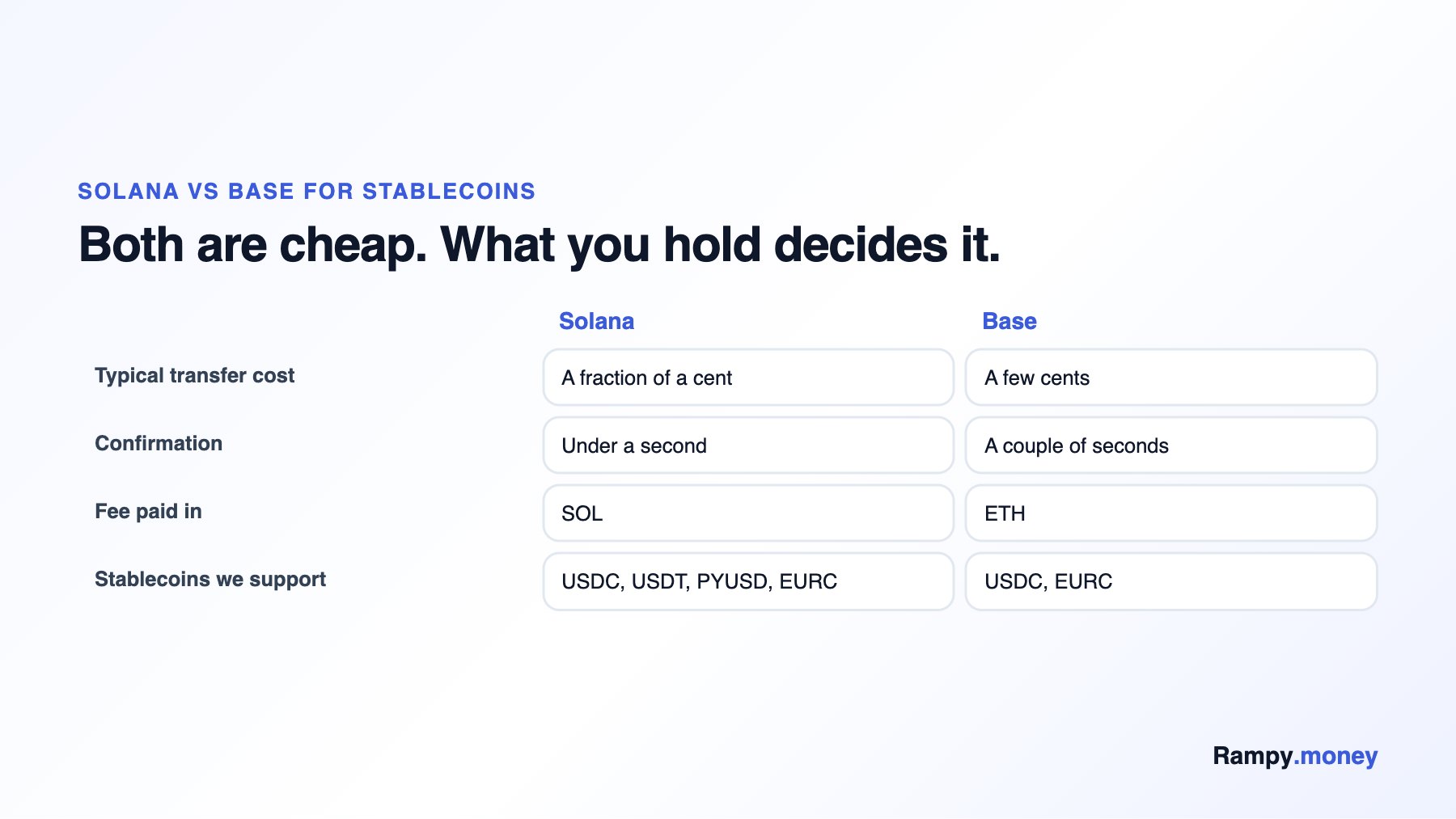
For years the answer to "which network should I use" was simply whichever one is not Ethereum. Now that there are several cheap options, the question is more interesting. Solana and Base are the two most commonly reached for, and they are genuinely different things.
The costs, honestly
| Solana | Base | |
|---|---|---|
| Typical transfer cost | A fraction of a cent | A few cents |
| Confirmation | Under a second | A couple of seconds |
| Fee paid in | SOL | ETH |
| Stablecoins we support | USDC, USDT, PYUSD, EURC | USDC, EURC |
| Architecture | Its own chain | An Ethereum layer two |
Both are cheap enough that on any meaningful amount the network fee is a rounding error next to the provider fee. Choosing between them to save two cents is not the point. Choosing correctly to avoid a failed or stranded transfer is.
The gas trap, which applies to both
This catches people who received stablecoins as a payment and have never held the native token. Keep a few dollars of SOL or ETH in any wallet you intend to send from.
Where Solana wins
- It carries more of the stablecoins: USDT and PYUSD live there and do not live on Base.
- It is the cheaper and faster of the two, by a margin that matters if you are making many small transfers.
- Consumer wallets and payment apps have converged on it.
Where Base wins
- It is an Ethereum layer two, so it shares an address format with Ethereum and every other EVM chain — which makes moving between them straightforward, and makes a wrong-chain mistake recoverable rather than fatal.
- If your funds and tooling already sit in the Ethereum world, Base is a shorter journey than bridging to a different chain entirely.
- The bridge to and from Ethereum is well travelled.
Which to pick
- Whichever one your funds are already on. Moving between chains to save cents costs more than it saves.
- Solana, if you hold USDT or PYUSD — Base does not carry them.
- Base, if the rest of your activity is EVM and you value one address format across everything.
- Either, for USDC, where both are well supported and the cost difference is negligible.
And the general rule that outranks all of this: use the network the receiving side names, not the one you prefer. A cheap transfer to a chain the recipient does not support is not a cheap transfer.
Rampy supports USDC on both, plus USDT, PYUSD and EURC where they exist, across nine networks in total. 1.99% + 1.99 below 500, then 0.99% + 1.99 from 500 per order.
Pick your networkFrequently asked
Is Solana cheaper than Base?
Yes, but by a fraction of a cent against a few cents. On any meaningful amount the difference is irrelevant next to the provider's fee.
Can I send USDT on Base?
Not through us. Base carries USDC and EURC; USDT lives on Ethereum, Solana and Tron. Sending an asset to a chain that does not carry it is how funds get stranded.
Why does my transfer fail when I hold plenty of USDC?
Because moving a token costs the network's own coin. You need a small amount of SOL on Solana or ETH on Base. The insufficient-funds error refers to the gas token, not your stablecoin.
Is Base safer because it is an Ethereum layer two?
Different, rather than safer. It inherits Ethereum's settlement and shares its address format, which makes a wrong-chain send within the EVM family usually recoverable. Solana's separate format prevents that mistake in the first place.