How to Swap USDT to USDC (and When You Should Not Bother)
Moving between two dollar stablecoins looks like it should be free and instant. It is neither, and it is probably a taxable event.
USDT and USDC both aim at one dollar, so swapping one for the other feels like it should be a rounding error. It is not. There is a fee, there is a network cost, and in most tax systems there is a disposal — you have sold one asset and acquired another, regardless of the fact that both are worth about a dollar.
Why people swap
- A counterparty or platform only accepts one of the two.
- Moving to a cheaper network, since USDT and USDC are not equally available everywhere.
- Preferring USDC's reserve reporting, or preferring USDT's liquidity in a particular market.
- Consolidating a wallet holding fragments of both.
And the reason not to: because you saw a slightly better rate somewhere. The difference between two dollar stablecoins is rarely large enough to cover the cost of moving between them.
The three ways to do it
| Route | Typical cost | Custody |
|---|---|---|
| Centralised exchange | 0.1%–0.5% plus withdrawal | Theirs, while they hold it |
| Decentralised exchange | 0.05%–0.3% plus network fee and slippage | Yours throughout |
| A conversion service | A flat percentage | Yours throughout |
Ours is 0.5% of the amount, with no flat fee, minimum 20, charged in the asset you send. The same rate applies to any amount, so a small swap costs no more, proportionally, than a large one.
The network matters more than the fee
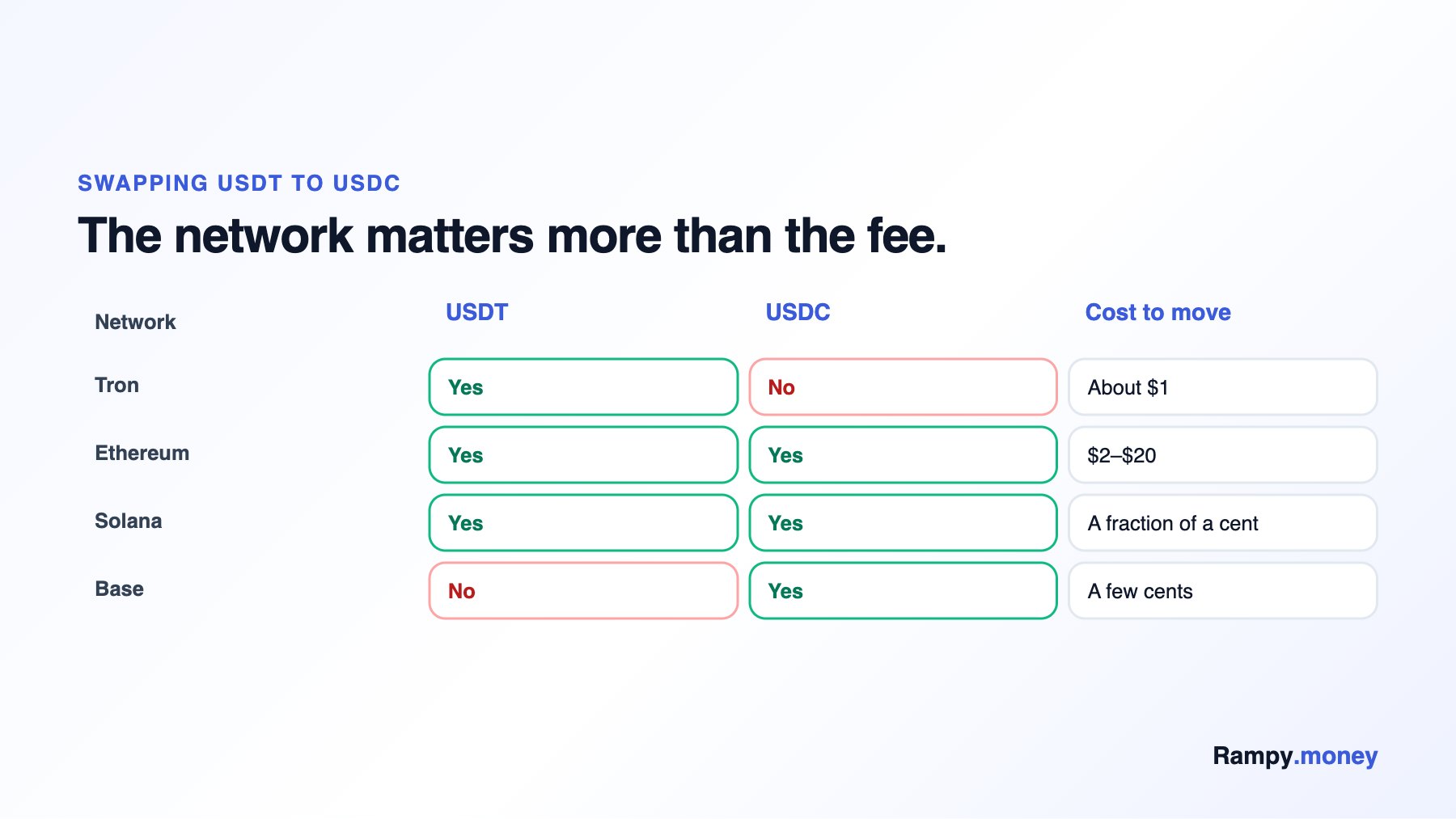
USDT and USDC do not live on the same set of chains. USDT's home is Tron; USDC's breadth is on Ethereum and its layer twos. A swap that also changes network is doing two things at once, and the network cost can exceed the swap fee comfortably.
| Network | USDT | USDC | Cost to move |
|---|---|---|---|
| Tron | Yes | No | About $1 |
| Ethereum | Yes | Yes | $2–$20 |
| Solana | Yes | Yes | A fraction of a cent |
| Base | No | Yes | A few cents |
The tax point people miss
In most jurisdictions, exchanging one crypto asset for another is a disposal of the first. The gain is usually tiny — pennies, on assets that both track a dollar — but the event still happened and still belongs in your records. Someone who swaps regularly can generate a long list of near-zero disposals that still have to be reported.
That is a reason to swap deliberately rather than habitually. This is general information and not tax advice; the treatment varies by country.
When not to bother
- When you are about to cash out anyway. Convert straight to your bank rather than swapping first and paying twice.
- When the amount is small. A percentage fee plus a network fee on $50 is a meaningful proportion of it.
- When you only want a slightly better quoted rate. The spread between two dollar stablecoins rarely covers the cost of the move.
- When the platform you are heading to accepts both anyway.
Rampy swaps between USDC, USDT, EURC and PYUSD across nine networks for 0.5% of the amount, with no flat fee. Non-custodial, and the assets never leave your control.
Swap stablecoinsFrequently asked
Is swapping USDT to USDC taxable?
In most jurisdictions yes — it is a disposal of one asset and acquisition of another, even though both track the dollar. The gain is usually negligible, but the event is still reportable. Confirm the rules where you live.
What is the cheapest way to swap USDT for USDC?
On a cheap network you already hold on. Solana carries both and costs a fraction of a cent to move; Tron carries USDT but not USDC, so any swap out of Tron USDC-ward also crosses chains.
Can I swap between networks at the same time?
Yes, but understand that you are doing two things at once and the network cost may exceed the swap fee. Always confirm the destination network supports the asset you are receiving.
Does a swap cost the same as a buy or a sell?
No. A swap is 0.5% of the amount, with no flat fee, charged in the asset you send. A buy or a sell is 1.99% + 1.99 below 500, then 0.99% + 1.99 from 500.