Crypto Off-Ramp for Businesses: Converting Stablecoins to Company Money
Getting paid in stablecoins is easy. Getting those stablecoins into a company account, with records an accountant will accept, is where it gets real.
More companies are being paid in stablecoins — agencies with overseas clients, software firms selling to crypto businesses, contractors who would rather not wait five days for a wire. The receiving part is easy. The part nobody warns you about is that a business off-ramp is a different product from a personal one, with different verification, different questions, and a bookkeeping burden that a personal account does not carry.
A business account is not a personal account with a company name on it
Verifying a company means verifying the company and the people behind it. Expect to provide all of the following, and to have them ready rather than hunting for them mid-application.
- Certificate of incorporation and the company's registered number.
- Proof of the registered address.
- Identity documents for every director and every beneficial owner above the ownership threshold, usually 25%.
- A description of what the business actually does and where its money comes from.
- A company bank account in the company's own name.
One-off orders or a permanent account
There are two shapes this takes, and the right one depends on how often money arrives.
| One-off order | Permanent deposit account | |
|---|---|---|
| How it works | You place an order for a specific amount, then send it | Bank details in your name that convert anything paid in |
| Best for | Occasional, irregular conversions | Recurring revenue, invoices, payroll funding |
| Our price | 1.99% + 1.99 below 500, then 0.99% + 1.99 from 500 per order | 1.99% of what arrives, no fixed fee |
| Cancellable | Yes, until you send the funds | No — anything that arrives is converted |
A permanent account is usually the right answer for a business, because it removes a step from every invoice: you give the details once, and money paid in converts on arrival without anyone placing an order. The trade-off is that there is nothing to cancel. Paying in twice converts twice.
The bookkeeping that keeps an accountant happy
This is the part that gets neglected until year end. For every conversion you want, at minimum: the date and time, the amount of stablecoin sent, the fiat amount received, the fee charged, the transaction hash, and the invoice or customer the payment relates to. Without the last one, your accountant has a bank credit with no revenue attached to it.
Two accounting points worth raising with your accountant early, because they change how you record things:
- In most jurisdictions a stablecoin is not cash. It is an asset you hold, so receiving one is revenue at that day's value and converting it later can produce a small gain or loss.
- The provider's fee is a business expense, separate from the revenue. Recording only the net amount that hit the bank understates both.
Sanctions and screening, which is not optional
A business moving other people's money attracts more scrutiny than an individual moving their own. Providers screen the wallets that pay you, not just you. If a customer pays an invoice from an address associated with a sanctioned entity or a known exploit, that payment can be frozen and you will be asked about it — and the honest answer, that you simply invoiced somebody, still takes time to establish.
The practical defence is boring and effective: know who your customers are, invoice them properly, and keep the paperwork. A conversion you can explain in one sentence with a document attached rarely becomes a problem.
Choosing a rail
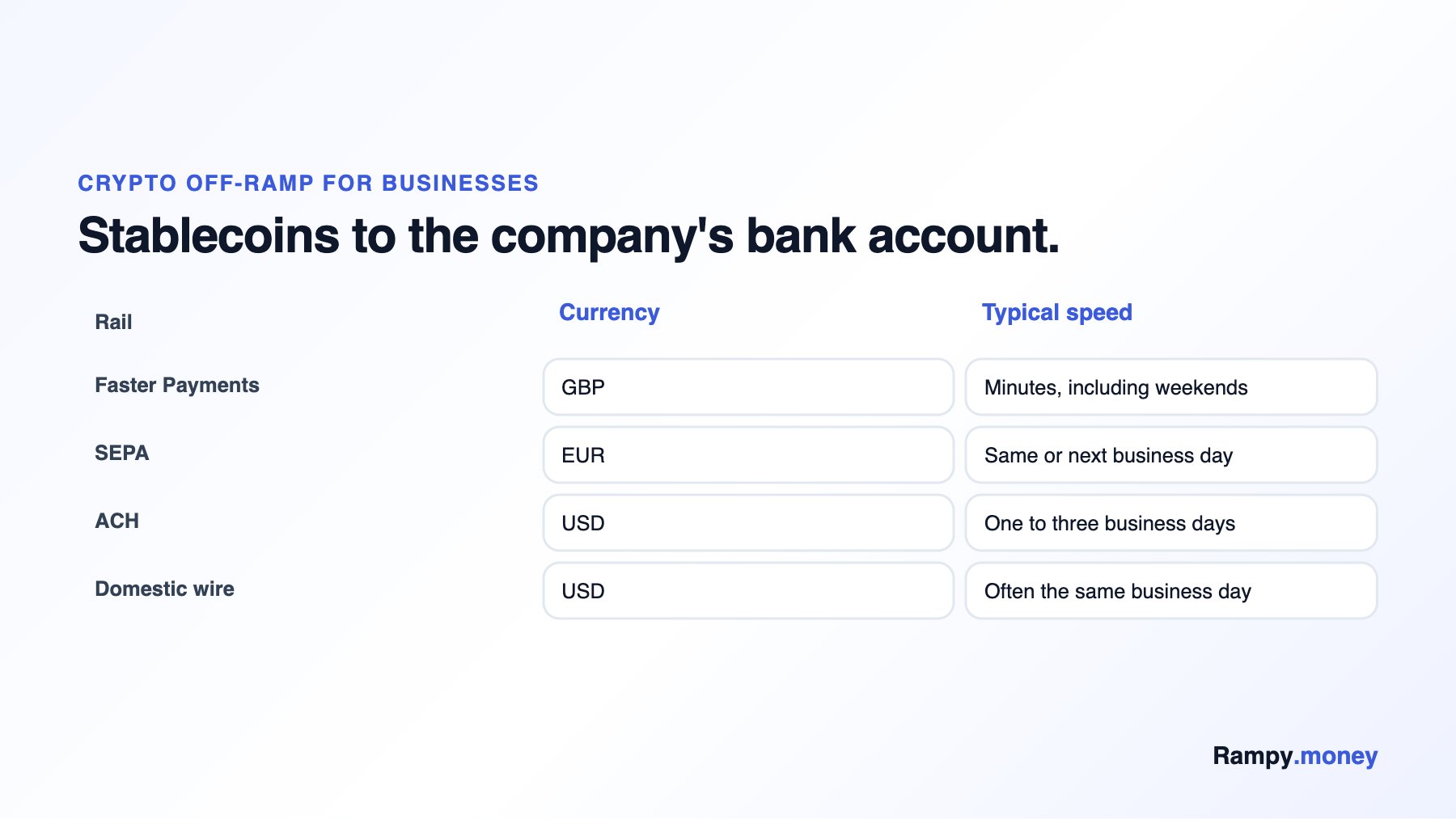
Which currency you convert into decides how fast the money lands and which account it can reach.
| Rail | Currency | Typical speed |
|---|---|---|
| Faster Payments | GBP | Minutes, including weekends |
| SEPA | EUR | Same or next business day |
| ACH | USD | One to three business days |
| Domestic wire | USD | Often same business day, at a higher cost |
Rampy separates business and personal accounts, verifies companies properly, and gives a business permanent deposit details it can put on an invoice. Conversions are 1.99% on a deposit account, 1.99% + 1.99 below 500, then 0.99% + 1.99 from 500 on a one-off order.
Open a business accountFrequently asked
Can a company use a personal crypto off-ramp?
No. A personal account is for the person verified on it, and using one to transact for a business breaks the terms and is grounds for closing it. It also mixes company and personal money, which your accountant and your auditor will both object to. A personal account can pay a company it owes money to, as somebody else's account with its name and address, but company revenue belongs in a business account.
Why does a business signup need a company email address?
It is the cheapest evidence that the applicant is connected to the company. A free email address gives a reviewer nothing to check, so a business account cannot be opened from one.
Is receiving stablecoins revenue at the time of receipt?
In most jurisdictions yes: revenue is recognised at the value on the day you receive it, and any movement between then and conversion is a separate gain or loss. Confirm with your accountant, as treatment varies by country.
What happens if a customer pays us from a flagged wallet?
The payment can be held while it is investigated. Providers screen incoming addresses, not just customers. Keeping proper invoices and knowing who your customers are is what resolves it quickly.